 StackScopes
A cloud alert usually begins with a resource: database connections are exhausted, a queue is throttled, a certificate is expiring, or a security-group change has blocked traffic. The business question begins somewhere else: which capabilities, teams, customers, or tenants could be affected, how quickly, and through which dependency paths?
Cloud blast radius analysis connects those two perspectives. It traces the effect of a failure or proposed change through a model of resources, workloads, dependencies, redundancy, and operational context. A useful analysis distinguishes direct from transitive impact, explains each path, identifies uncertainty, and avoids presenting every reachable node as equally affected.
This article presents a practical method for cloud blast radius analysis. It covers graph traversal, critical paths, workload criticality, fallback and redundancy, customer and tenant mapping, time-to-impact, recovery complexity, pre-change and incident workflows, and a hypothetical database failure. It also explains why a dramatic topology diagram is not enough: blast radius is a reasoned result that depends on evidence and explicit assumptions.
Table of contents
- What blast radius means in cloud systems
- Direct and indirect impact
- The model required for analysis
- Dependency traversal without overstatement
- Critical paths and workload criticality
- Redundancy and fallback
- From workloads to customers and tenants
- Time-to-impact
- Confidence and explainability
- Recovery complexity
- Pre-change blast radius
- Incident-time blast radius
- Hypothetical database-failure example
- Limitations and trade-offs
- Key takeaways
- Frequently asked questions
What blast radius means in cloud systems
The phrase “blast radius” describes the scope of potential impact originating from a failure, compromise, or change. In cloud operations, the initiating condition may be:
- A resource becoming unavailable
- A resource becoming degraded
- A configuration property changing
- A permission being removed or broadened
- A network path being interrupted
- An Availability Zone or Region assumption
- A dependency returning incorrect data
- A Terraform plan replacing a shared component
- A credential, key, or certificate becoming unusable
The blast radius is not simply the number of resources connected to the initiating node. Reachability is a starting point. Impact depends on the semantics of each relationship, alternative paths, workload behavior, timing, criticality, and the confidence of the evidence.
For example, 100 workloads may have permission to read a KMS key, while only four use it. Two of those may have cached data and continue operating. One may be a non-production batch job. A graph traversal that labels all 100 workloads “down” would be fast and wrong.
A defensible analysis asks:
- What scenario are we evaluating?
- Which resource properties or capabilities change?
- Which direct dependents require those capabilities?
- Which effects propagate through downstream services?
- Which redundant or fallback paths remain?
- How long before each effect becomes visible?
- Which business capabilities rely on the affected workloads?
- Which tenants or customer journeys are in scope?
- How strong is the evidence for each path?
- What recovery dependencies influence duration?
The result is better expressed as a set of paths and impact states than a single score.
Direct and indirect impact
Direct impact occurs at resources or workloads immediately dependent on the initiating condition. If a security-group rule blocks application traffic to a database, the application tasks using that path are directly affected. If a KMS key cannot decrypt a queue, the queue’s consumers may be directly unable to process encrypted messages.
Indirect, or transitive, impact propagates through additional dependencies. If checkout tasks cannot write orders, fulfillment receives no new messages, the operations dashboard becomes stale, and customers cannot complete purchases. Fulfillment is not connected directly to the database, but it is affected through the checkout capability.
It is useful to represent multiple states:
- Unavailable: Required function cannot proceed.
- Degraded: Function continues with reduced performance or features.
- At risk: A path could fail under current assumptions, but evidence is incomplete.
- Delayed: Asynchronous processing continues later or backlog grows.
- Unaffected: A verified alternative path remains.
- Unknown: Coverage or behavior is insufficient to decide.
These states prevent the analysis from treating every node as binary. They also support more accurate communication. A reporting pipeline delayed by two hours should not be described in the same way as a login service that rejects all requests.
Direct and indirect impact need separate presentation. Responders want to know where to intervene first, while incident leaders need the wider customer context. A useful interface can group affected entities by distance from the initiating condition and explain the propagation chain.
The model required for analysis
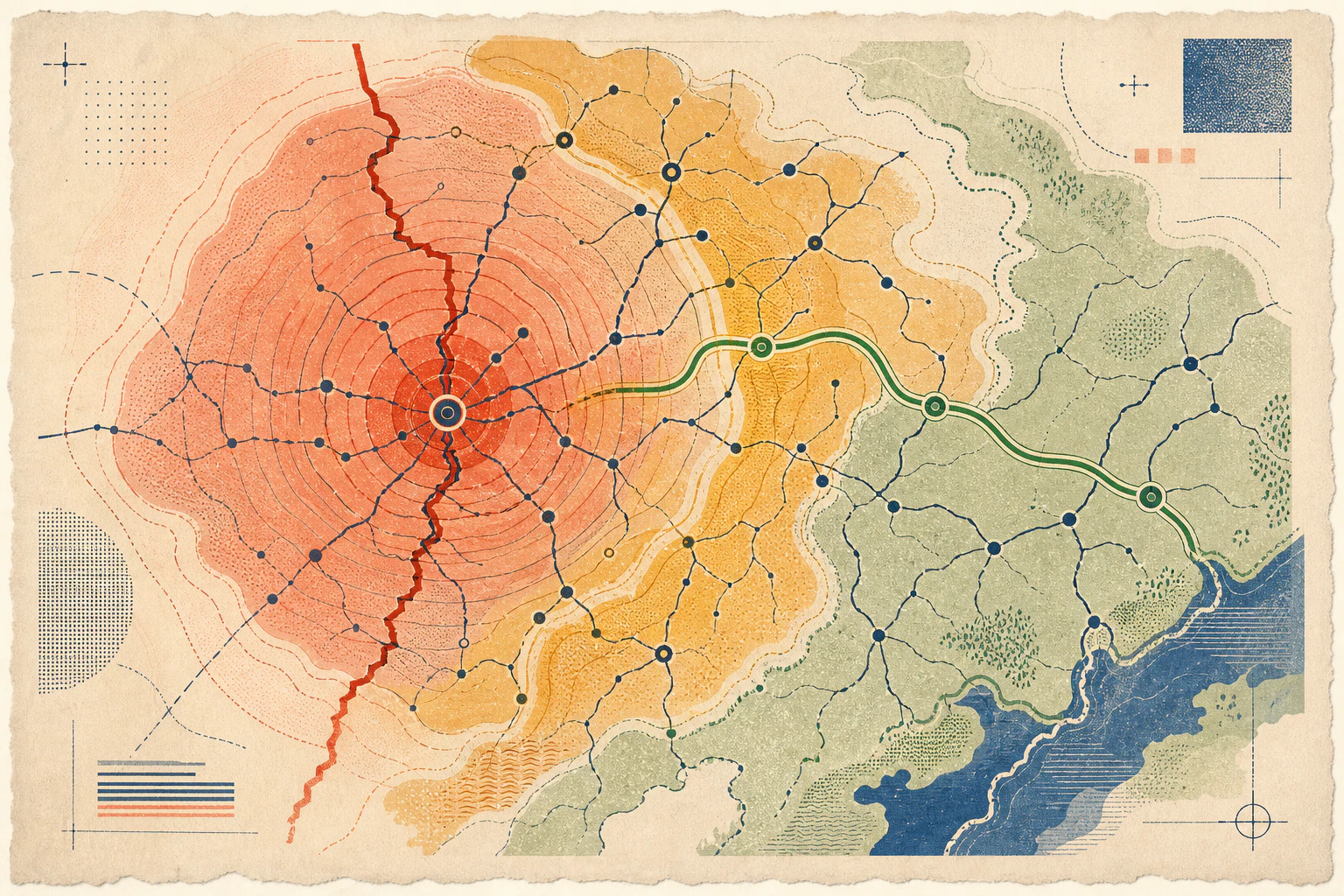
Cloud blast radius analysis depends on an infrastructure and workload graph with enough context to represent behavior.
Resource nodes
Resource nodes include databases, load balancers, compute, functions, queues, topics, buckets, roles, keys, secrets, subnets, route tables, endpoints, DNS records, certificates, and other infrastructure. Each needs stable identity across account and Region.
Workload and capability nodes
Infrastructure alone does not identify business impact. Resources should be connected to applications, services, customer capabilities, operational processes, and owners. A capability might be “user authentication,” “checkout,” “file export,” or “billing reconciliation.”
Typed dependency edges
Edges should express why a connection matters: reads from, writes to, routes through, assumes, decrypts with, resolves through, publishes to, consumes from, or is deployed in. Each type has different propagation behavior.
Temporal state
The active graph should correspond to the scenario time. During an incident, current topology may already differ from the pre-incident state. Historical edges help investigators reconstruct the path before a rollback or automatic replacement changed it.
Evidence and confidence
Every important edge should cite configuration, infrastructure-as-code, runtime observation, an event, or human validation. Confidence and freshness are part of the analysis, not optional metadata.
Operational properties
Required-versus-optional status, fallback behavior, buffer capacity, criticality, owner, RTO, RPO, and recovery prerequisites make the difference between reachability and impact.
Without these elements, a system can still produce a neighborhood graph, but it should not present the result as reliable customer impact.
Dependency traversal without overstatement
Graph traversal begins at the changed or failed node and follows edges toward dependents. The traversal algorithm must be aware of relationship semantics.
Consider a service that writes to a queue. If the queue is unavailable:
- The service may fail requests immediately.
- It may buffer messages locally.
- It may use a secondary queue.
- It may accept requests but delay fulfillment.
- It may drop noncritical events.
The edge “publishes to” does not encode which behavior applies. The model needs an impact rule or a documented assumption.
A traversal can use three layers:
- Structural reachability: Which nodes are connected through relevant edges?
- Behavioral evaluation: For each path, is the relationship required, optional, buffered, or redundant?
- Context projection: Which workloads, capabilities, teams, tenants, or recovery objectives map to affected nodes?
Cycle handling also matters. Distributed systems contain feedback loops, event subscriptions, and bidirectional communication. The algorithm should track visited state and evaluate meaningful transitions rather than recurse indefinitely.
Graph distance is not the same as severity. A directly dependent batch job can be low priority; a three-hop authentication path can be critical. Sort results using business criticality, customer exposure, evidence, time-to-impact, and recovery complexity rather than hop count alone.
The traversal should return the path that supports each conclusion. “Checkout may be unavailable because checkout-api requires orders-db through endpoint X” is actionable. “Impact score 87” is not, unless the score is accompanied by the same evidence.
Critical paths and workload criticality
A critical path is a dependency path whose loss prevents a required capability from meeting its operational objective. Critical paths are contextual. The same queue may be critical to real-time fraud checks but only delay analytics.
Workload criticality should be established through an owned classification process rather than guessed from cloud spend or request volume. Useful inputs include:
- Customer-facing importance
- Safety or security implications
- Revenue or contractual relevance, where verified
- Recovery time objective
- Recovery point objective
- Data integrity requirements
- Operational deadline
- Availability dependency
- Availability of manual workaround
- Owner and escalation path
Avoid turning these inputs into a false universal ranking. A platform team can use tiers or named objectives while retaining the underlying reasons.
Critical-path analysis can also identify shared dependencies. Multiple redundant application instances can still share one DNS zone, KMS key, identity provider, NAT gateway, or configuration service. The apparent redundancy at the compute layer does not protect against that common dependency.
Conversely, visual fan-out does not always indicate criticality. A centralized logging destination may receive data from every service, but its outage may not stop customer requests. The effect could be an observability and compliance risk rather than application unavailability. Typed relationships and impact rules preserve that nuance.
Redundancy and fallback
Blast radius is often overestimated when the graph records dependencies but not alternatives.
Redundancy can exist at several levels:
- Multiple instances behind a load balancer
- Multi-AZ database configuration
- Replicated queues or streams
- Secondary DNS or endpoint paths
- Cached credentials or configuration
- Graceful feature degradation
- Manual operational workaround
- Cross-Region recovery environment
The presence of two nodes does not prove effective redundancy. They may share a subnet, route, key, identity provider, control plane, or failure mode. Analysis should verify independence of critical dependencies.
Fallback paths also have activation conditions. A database reader may be promoted only through a manual process. A cross-Region environment may require data reconciliation. A cache can serve stale data for a limited time. Record whether fallback is automatic, manual, tested, and currently ready.
Capacity matters. A secondary path can be healthy but unable to absorb full load. Without verified capacity data, mark the conclusion as conditional.
Redundancy evaluation can follow this pattern:
- Identify all paths that satisfy the required capability.
- Remove or degrade the scenario node.
- Test whether at least one valid path remains.
- Check for shared dependencies among remaining paths.
- Evaluate activation requirements and capacity assumptions.
- Report evidence and uncertainty.
This approach avoids the simplistic claim that a multi-AZ label eliminates impact. It also prevents the opposite mistake of marking a workload down when a verified alternative remains.
From workloads to customers and tenants
Resource impact becomes operationally meaningful when connected to customer-facing capabilities and tenant boundaries.
The mapping can include:
- Resource → workload
- Workload → service
- Service → customer capability
- Capability → customer journey
- Workload or data partition → tenant
- Capability → owner and communication channel
This context should come from authoritative service catalogs, deployment metadata, routing or tenancy configuration, and owner validation. Do not infer named customers from infrastructure metadata without a lawful and accurate basis.
Tenant impact is particularly nuanced. A shared database outage may affect all tenants. A failed shard may affect a subset. A queue partition or regional routing issue may affect tenants assigned to one path. The model needs the tenancy rule, not just a “multi-tenant” label.
Data minimization is essential. Blast-radius analysis usually needs tenant identifiers or groups, not personal data. Sensitive customer details should not be copied into a topology graph when a controlled reference is sufficient.
Customer impact should also avoid unsupported financial estimates. A platform may show affected capabilities, tenant groups, transactions at risk, or operational deadlines if those inputs are reliable. Turning that into revenue loss requires business data and explicit modeling beyond infrastructure reachability.
During an incident, impact projections support communication but should be labeled by confidence. “Tenants routed through shard B may be affected” is more honest than “all customers are down” when evidence is incomplete.
Time-to-impact
Failures propagate at different speeds. Time-to-impact is the estimated delay between the initiating condition and an effect on a dependent capability.
Examples:
- A synchronous database connection failure may affect requests in seconds.
- Expired cached credentials may take effect when the cache refreshes.
- An unavailable queue may create a backlog before a customer deadline is missed.
- Object-storage failure may affect only the later export stage.
- A certificate expiration has a known future threshold.
- Loss of a backup process may not affect production immediately but increases recovery risk.
Time-to-impact can be based on:
- Client timeouts and retries
- Cache time-to-live
- Queue retention and backlog rate
- Scheduled job intervals
- Credential expiration
- Circuit-breaker behavior
- Failover detection and activation time
- Operational runbook estimates
These are assumptions unless verified from configuration or tests. The analysis should show ranges and sources rather than precise timestamps without evidence.
A timeline view helps teams prioritize. Immediate synchronous impact may require urgent containment. A six-hour backlog window may allow a careful fix. A degraded backup path may demand action before the next recovery objective is jeopardized.
Time also changes the blast radius. As buffers exhaust, more dependents can transition from unaffected to delayed or unavailable. A simulation should support these state transitions rather than produce one static snapshot.

Confidence and explainability
Blast-radius results can influence incident declarations and deployment decisions. Operators need to understand why each result exists.
Confidence has at least three dimensions:
- Topology confidence: How certain is the dependency?
- Behavior confidence: How certain is the required, optional, fallback, or buffered behavior?
- Scenario confidence: How realistic are the failure assumptions?
A direct configuration reference plus recent runtime evidence can support strong topology confidence. Required behavior may still be unknown if the application handles errors in code. A failure scenario that assumes total regional loss carries different uncertainty from removing one security-group rule.
Explainability should include:
- Initiating condition
- Affected property
- Dependency path
- Edge types
- Supporting evidence
- Observation time
- Alternative paths considered
- Assumptions
- Coverage gaps
- Owner validation
Confidence should not hide disagreement. If infrastructure-as-code declares a fallback but runtime observations never use it, show both facts. That discrepancy can trigger a resilience test.
AI can summarize long paths and group similar effects, but the underlying evidence must remain inspectable. A generated explanation is not a substitute for graph provenance.
Recovery complexity
Two incidents with the same affected workload count can require very different recovery effort.
Recovery complexity depends on:
- Number of dependent systems
- Order constraints
- Data consistency requirements
- Required permissions
- Cross-team coordination
- Manual approvals
- Fallback activation
- Rollback safety
- Validation steps
- Backup and restore processes
- External-provider involvement
- Uncertain topology
The graph can help derive a dependency-aware recovery order. Identity, network, secret, and data services may need restoration before application workloads. A queue consumer should not resume if its destination database remains unavailable and duplicate processing is unsafe.
Recovery analysis should identify prerequisites and checkpoints, not issue unrestricted production actions. A controlled workflow separates read-only investigation from remediation permissions and requires human approval for production-impacting steps.
Recovery complexity also informs incident planning before failure. A shared resource with modest immediate blast radius but a difficult, untested recovery path can deserve higher priority than its degree count suggests.
Pre-change blast radius
The best time to understand blast radius is before deployment.
Inputs can include:
- Terraform plan
- CloudFormation change set
- Proposed IAM policy
- Security-group diff
- Route change
- Database modification
- Certificate or DNS update
The process is:
- Resolve changed objects to active topology nodes.
- Identify property-level effects.
- Evaluate direct dependents.
- Traverse transitive paths using relationship rules.
- Account for redundancy and fallback.
- Project affected workloads and capabilities.
- Show evidence, confidence, and coverage gaps.
- Suggest review questions and safer alternatives.
Property-level analysis is important. Adding a tag should not carry the same impact as replacing a subnet. Tightening one ingress rule affects only matching paths. A broad node-removal assumption can overstate risk.
The output should support review, not automatically block every change. A high-confidence path to a critical workload may justify approval or staging requirements. An uncertain path may trigger owner confirmation. A safe change with no relevant dependents can proceed with ordinary controls.
Incident-time blast radius
During an incident, the initiating condition may be uncertain. Analysis can begin from:
- An alerting resource
- A recent change
- An observed error path
- A security finding
- A degraded capability
Starting from the alerting resource provides downstream impact. Starting from a degraded capability and traversing toward dependencies supports root-cause exploration. Teams often need both directions.
Temporal context is crucial. Compare topology before and after the incident window. A rollback can remove the changed resource before investigation begins. CloudTrail events, configuration history, deployment metadata, and observed state help reconstruct what happened.
Incident outputs should support:
- Affected capability list
- Likely tenant scope
- Critical dependency paths
- Owners to involve
- Alternative paths
- Time-to-impact progression
- Recovery prerequisites
- Confidence and unknowns
Do not let the analysis delay containment. It should organize evidence and update as new facts arrive. Human incident command remains responsible for decisions.
Hypothetical database-failure example
Hypothetical scenario: A SaaS application operates three customer capabilities: account login, checkout, and reporting. Login uses a managed identity provider and a session store. Checkout uses an ECS service and an Aurora PostgreSQL cluster. Reporting reads from a replica populated asynchronously. All services retrieve selected configuration through the same VPC endpoint.
At 10:00, the primary Aurora writer becomes unavailable.
Direct effects
The checkout service cannot commit new orders through the writer endpoint. Connection errors are recent and repeated. Topology confidence is high because the task configuration references the database secret and traces show the request path.
The reporting service reads a separate replica. It remains available initially, though freshness may degrade because replication from the writer stops.
Login does not use the database and remains available.
Transitive effects
Because checkout does not publish fulfillment messages until a transaction commits, fulfillment receives no new orders. Its resources remain healthy, but the business process is delayed.
The customer order-history view reads the same cluster. It becomes unavailable even though it is owned by another team.
An operations dashboard reads event data from the queue and appears quiet. That absence is an indirect symptom, not evidence that customer demand stopped.
Redundancy evaluation
The cluster has a reader instance that may be promoted according to AWS and application recovery procedures. The model records this as a recovery option, not an immediately active write path. Promotion time, DNS behavior, client retry, and data-consistency assumptions remain visible.
Customer and tenant projection
Checkout is shared across all tenants in the Region, so all tenants routed there may be affected. Reporting remains readable but can become stale. No customer names are required in the graph; controlled tenant-group identifiers are sufficient.
Time-to-impact
Checkout impact is immediate after client retries expire. Fulfillment delay begins immediately but does not violate its operational deadline until a documented threshold. Reporting freshness degrades over time.
Recovery complexity
Recovery requires validating cluster state, selecting or promoting a writer, confirming application connectivity, checking transaction consistency, monitoring queue resumption, and verifying order-history behavior. The dependency order prevents responders from restarting consumers before the data layer is ready.
Result
The blast radius is not “one failed database and 23 affected resources.” It is a structured explanation:
- Checkout unavailable
- Order history unavailable
- Fulfillment delayed
- Reporting available but becoming stale
- Login unaffected
- Regional tenant group potentially affected
- Recovery path available with stated assumptions
That result supports precise incident communication and a testable recovery plan.
Limitations and trade-offs
Incomplete dependencies
Undiscovered external APIs, dynamic configuration, missing telemetry, or insufficient permissions can omit paths. Coverage gaps must remain visible.
Application behavior
Infrastructure configuration cannot fully predict retries, feature flags, error handling, or data consistency. Validate important assumptions through tests and owner review.
Changing topology
The graph can become stale between collection cycles. Refresh relevant state before high-risk decisions and retain observation time.
False positives
Permissions and historical traffic can create reachable paths that are not operationally required. Typed evidence and criticality reduce overstatement.
Customer mapping sensitivity
Tenant context can be sensitive. Use minimal identifiers, authorization, retention controls, and auditability.
Simulation fidelity
Model-based analysis explores stated scenarios; it does not guarantee production outcomes. Complement it with staged tests, observability, backups, runbooks, and carefully governed chaos experiments.
Cognitive overload
Large blast-radius graphs can overwhelm responders. Present prioritized paths, grouped capabilities, and explainable filters instead of every node.
Key takeaways
- Blast radius is potential operational impact, not simply graph reachability.
- Direct and transitive effects should be shown separately.
- Typed dependencies, workload context, and temporal state are prerequisites for useful analysis.
- Redundancy must be evaluated for shared dependencies, capacity, activation, and readiness.
- Customer and tenant impact requires explicit mapping and data-minimization controls.
- Time-to-impact helps distinguish immediate outages from delayed degradation.
- Confidence should cover topology, behavior, and scenario assumptions.
- Recovery complexity can matter as much as affected-resource count.
- Pre-change analysis and incident analysis use the same graph in different directions.
- Results should show paths and evidence rather than rely on an opaque score.
Frequently asked questions
Is blast radius the number of affected resources?
No. Resource count can be a useful summary, but impact depends on dependency type, workload criticality, redundancy, time, and customer context.
Can blast radius be calculated before a change?
Yes. A proposed infrastructure diff can be mapped to current topology and evaluated using property-level effects, dependencies, fallback paths, and confidence.
How does blast-radius analysis identify affected customers?
Resources must be mapped to workloads, capabilities, and tenant-routing or data-partition context. The analysis should use controlled identifiers and avoid unnecessary personal data.
Does a Multi-AZ configuration guarantee no impact?
No. It provides a resilience mechanism for supported failure modes, but application behavior, shared dependencies, capacity, failover timing, and operational readiness still matter.
Should blast-radius results trigger automatic remediation?
Not by themselves. Results can inform a recovery plan, but production-impacting actions should use separate permissions, policy constraints, auditability, validation, and human approval.
Conclusion
Cloud blast radius analysis turns an isolated technical event into a system-level explanation. It traces which paths could fail, which alternatives remain, when consequences may appear, and which customer capabilities or tenants are in scope.
The analysis is only as credible as its model. Stable identity, typed dependencies, temporal state, explicit business context, visible evidence, and honest uncertainty are more important than a colorful graph. When these elements are maintained continuously, the same model can improve pre-change review, incident triage, resilience planning, and recovery sequencing—without claiming certainty that the available evidence cannot support.
Primary sources and further reading
- AWS Well-Architected Reliability Pillar
- AWS Fault Isolation Boundaries
- Amazon Aurora high availability
- AWS Config
- AWS CloudTrail
- OpenTelemetry traces
Related StackScopes reading
Continue exploring
Map the path behind the risk.
Explore cloud topology, failure simulation, blast radius, and evidence-backed recovery with StackScopes.