 StackScopes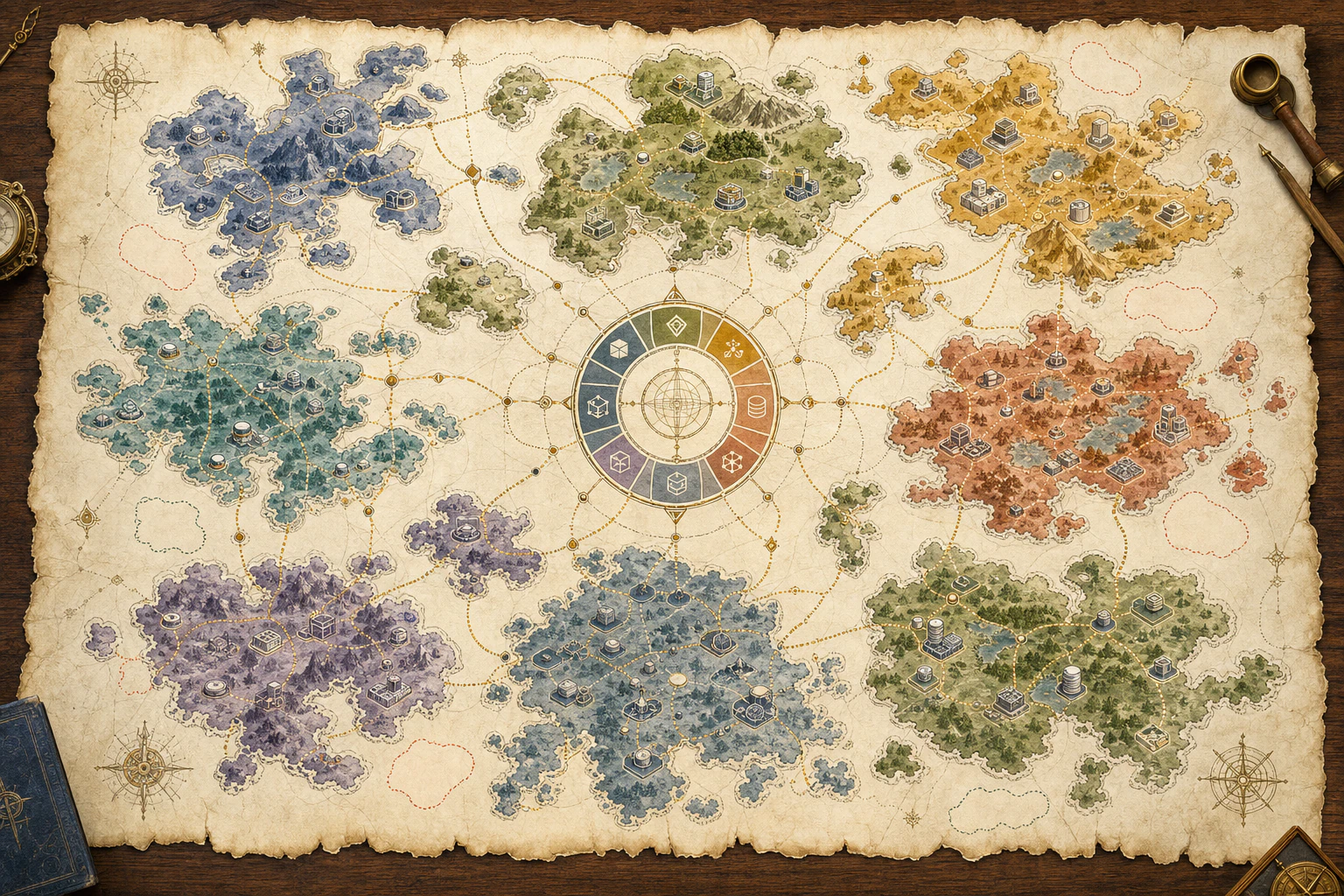
AWS accounts and Regions are valuable isolation boundaries. They separate workloads, environments, teams, billing, policies, and failure domains. They also fragment operational context. A platform engineer investigating one service may need to connect DNS in a networking account, compute in an application account, a shared event bus in another account, and a replicated database in a second Region.
Multi-account AWS visibility is therefore not an exercise in placing every resource into one large list. It requires stable identity, boundary-aware discovery, normalized relationships, temporal state, explicit partial-failure handling, and query patterns that remain useful as environments grow.
This article describes the engineering model: organization context, account and Region scope, global resources, naming collisions, throttling, pagination, incremental updates, graph partitioning, tenant isolation, and operational trade-offs. It deliberately avoids invented scale benchmarks; design choices should be tested against the environment that will use them.
Table of contents
- Why AWS boundaries fragment context
- Define the visibility contract
- Organization and account boundaries
- Region boundaries and global services
- Stable resource identity
- Inconsistent names and tags
- Cross-account relationships
- Discovery orchestration
- Pagination, throttling, and retries
- Partial failure and freshness
- Incremental discovery and reconciliation
- Graph storage and partitioning
- Tenant isolation
- Hypothetical topology
- Operational trade-offs
- Practical adoption path
- Key takeaways
- Frequently asked questions
Why AWS boundaries fragment context
A single application can span:
- An AWS Organizations hierarchy
- Separate production and non-production accounts
- Central identity, security, logging, and networking accounts
- Multiple Regions
- Global edge and DNS services
- Cross-account IAM roles
- Shared VPCs or Transit Gateway
- Event buses, topics, queues, or buckets with cross-account policies
- Infrastructure repositories and deployment systems outside AWS
Each service API returns a local perspective. EC2 describes resources in one Region. IAM is account-scoped and globally presented. Route 53 hosted zones do not fit a simple regional model. CloudFront is global. S3 bucket locations and replication relationships cross boundaries. Organizations metadata describes governance, not workload dependency by itself.
A naïve collector loops through accounts and Regions, concatenates responses, and calls the result visibility. This produces several problems:
- The same name appears in many scopes.
- Some resources are queried repeatedly as though regional.
- Deleted resources disappear without history.
- Cross-account relationships remain unresolved strings.
- A denied account looks like an empty account.
- A throttled API creates apparent resource deletion.
- Global and regional identifiers collide in queries.
- Fresh and stale states mix without warning.
The operational goal is to answer scoped questions: Which production capabilities depend on this shared route? What changed in one Region before an incident? Which accounts could be affected by a key-policy change? Where is discovery incomplete? Those questions require a model of boundaries, not a flattened inventory.
Define the visibility contract
Before implementation, define what “visible” means.
The contract should specify:
- Connected AWS accounts
- Intended organization or organizational-unit scope
- Included and excluded Regions
- Supported resource types
- Global services and their collection home
- Configuration fields collected
- Relationship types inferred
- Optional runtime or event evidence
- Expected refresh approach
- Retention for temporal state
- Data residency and tenant boundaries
- Coverage and freshness reporting
Visibility is never absolute. An account may not be connected; a role may deny IAM metadata; a Region may be disabled; an API may throttle; an external service may be outside AWS. The product should communicate scope and gaps.
Define completeness at several levels:
- Connection coverage: which intended accounts are connected?
- Regional coverage: which Regions were scanned successfully?
- Service coverage: which resource types and APIs completed?
- Relationship coverage: which evidence sources were available?
- Temporal coverage: from when is history retained?
- Runtime coverage: which traces, logs, or events were enabled and during what window?
A global “100% complete” badge is usually misleading. A workload-specific view can state that compute and database discovery are current while DNS context is unavailable.
The contract also controls security. Collect only required metadata, use read-only cross-account roles, and make optional sources separately authorized. More accounts do not justify broader unexamined permission.
Organization and account boundaries
AWS Organizations can provide hierarchy, account identifiers, names, status, and organizational-unit placement to an authorized management or delegated account context. This helps organize scope, but it does not automatically grant access to member-account resources.
Model organization entities as their own nodes:
- Organization
- Root
- Organizational unit
- Account
- Policy attachment
Use relationships such as contains, member_of, or policy_applies_to. Do not treat organizational placement as proof of runtime dependency.
Account identity should use the 12-digit account ID as the stable boundary, coupled with partition where relevant. Display names are mutable and non-unique. Preserve account aliases and organization names as attributes with observation time.
Cross-account discovery should use a dedicated customer-created role in each account or another explicitly governed enrollment mechanism. Bind each role ARN, expected account, external ID, allowed Regions, policy version, and tenant. After assumption, verify the account with STS before collection.
Account states matter. Suspended, closed, pending, or inaccessible accounts should not be silently removed. A historical graph can retain prior resources and mark current collection status. Organizations API semantics and retention should be checked against current official documentation rather than hard-coded assumptions.
Central accounts deserve special treatment:
- Networking account
- Security tooling account
- Log archive
- Shared services
- Identity
- Backup
- Deployment
Their resources often have broad downstream dependencies. Graph queries should preserve account ownership while allowing cross-account traversal.
Organizational policies can constrain actions, but evaluating effective permission across service control policies, identity policies, boundaries, and resource policies is nuanced. Model available policy evidence and uncertainty; do not claim a simple allow guarantees access.

Region boundaries and global services
Most AWS resource APIs are regional, so discovery needs an explicit Region list per account. Options include:
- Customer-selected Regions
- Enabled Regions from account metadata where authorized
- Organization policy-derived scope
- A configured default set
Do not blindly scan every known Region if the customer has not authorized or enabled it. Conversely, do not assume one home Region represents the account.
Every regional resource identity should include account, Region, service/type, and provider identifier. Region is more than a label: it is a failure, latency, compliance, and data-boundary dimension.
Global or quasi-global services require a collection strategy. Examples include:
- IAM
- Route 53
- CloudFront
- Organizations
- AWS account metadata
- Some S3 concepts with bucket-specific locations
Collect them once per relevant account or organization context, then attach global scope explicitly. Do not duplicate IAM roles under every Region merely because a worker loop queries them repeatedly.
Some services have a global control-plane view but regional data-plane implications. CloudFront distributions point to origins in Regions or outside AWS. Route 53 records can direct traffic across Regions. S3 bucket names are globally unique, while buckets have account ownership and location. The graph model should express these nuances instead of forcing every node into the same regional schema.
Cross-Region relationships include:
- Replication
- Backup copy
- Global databases
- DNS routing
- Event routing
- Artifact distribution
- Disaster-recovery dependencies
Represent direction and mode. Replication is not the same as failover readiness. A replica can be present without a tested promotion path, matching capacity, secrets, routes, or application configuration.
Stable resource identity
Identity is foundational. If two observations of the same resource become two nodes, history fragments. If two distinct resources collapse into one, dependency analysis becomes unsafe.
A canonical identity can include:
- Cloud partition
- AWS account ID
- Region or explicit global scope
- Service
- Resource type
- Provider-native stable identifier
Use ARNs when they are stable and semantically correct, but do not assume every resource exposes one or that ARN formatting alone solves lifecycle. Some resources use composite identifiers. Some replacements reuse names but receive new IDs. Some APIs return references in names, URLs, or partial IDs.
Store:
- Canonical internal ID
- Native ID
- ARN where available
- Account
- Region/global scope
- Type
- Name
- Lifecycle interval
- Source and observation time
Deletion should close a lifecycle interval rather than erase the node. A later resource with the same name but a new native ID should usually be a new node. This preserves incident history and prevents dependencies from being attached to the wrong generation.
Proposed resources from infrastructure plans need provisional identities. When created, reconcile them with live identifiers using deployment state, stack metadata, and attributes. Preserve the link between proposal and actual resource.
Aliases belong as attributes or alias nodes, not canonical identity. DNS names, tags, friendly names, and stack logical IDs can change or collide.
Identity resolution should expose ambiguity. If a string reference could match resources in two accounts, do not choose silently. Use surrounding evidence—account, Region, stack, policy, endpoint, and owner—to narrow candidates.
Inconsistent names and tags
Tags are valuable but unreliable. Teams misspell keys, change case, use different environment terms, inherit tags inconsistently, or put several meanings into one value.
Normalize for search without overwriting source truth. For example:
- Preserve original
Environment=Prod. - Derive normalized environment
productionthrough a documented rule. - Record the rule and confidence.
- Allow an owner to correct the mapping.
Do not use names or tags as the only identity. A payments-db can exist in development and production, or be replaced while keeping its name.
Useful semantic attributes include:
- Environment
- Workload or application
- Owner
- Criticality
- Data classification
- Cost center
- Tenant scope
Each can come from tags, account placement, repositories, service catalogs, or human validation. Preserve provenance and conflicts. If a tag says Team A while a service catalog says Team B, the disagreement is an actionable data-quality finding.
Avoid collecting every tag without review. Tags can contain personal or sensitive information. Allow inclusion, exclusion, and masking policies.
Naming inconsistency makes relationship resolution more difficult. A queue URL, ARN, environment variable, and Terraform address may refer to the same object in different forms. Normalization should be service-aware and boundary-aware.
Cross-account relationships
Cross-account topology emerges from several evidence types:
- IAM trust policies
- Resource-based policies
- KMS key policies and grants
- S3 bucket policies and replication
- SNS, SQS, and EventBridge resource policies
- RAM shares
- VPC peering and Transit Gateway
- PrivateLink services and endpoints
- Route 53 zone associations and resolver rules
- CloudFront origins
- Centralized logs and backups
- Deployment roles
An allowed policy path is not proof of use. Represent it as authorization evidence. Runtime events, flow logs, traces, or application configuration can strengthen an observed dependency.
Resolve both ends to tenant-authorized nodes. If the target account is not connected, create a bounded external or unresolved reference containing only safe evidence. Do not import another tenant’s data merely because an ARN appears in a policy.
Direction and semantics matter. A bucket policy allowing a security account to read logs creates an authorization path; configured log delivery creates a delivery dependency; a recovery process reading those logs creates an operational dependency.
Cross-account shared services can enlarge blast radius. A central event bus, resolver, Transit Gateway, artifact store, or KMS key might support many workloads. Query results should group downstream capabilities and owners rather than display an unreadable web.
Changes to a trust policy or resource policy should trigger reevaluation of affected paths. Temporal history can show when a relationship appeared, disappeared, or changed conditions.
Discovery orchestration
Separate orchestration from service-specific collection.
A discovery run can be modeled as:
- Resolve tenant-authorized account connections.
- Assume and verify the scoped account role.
- Determine authorized Regions and global scopes.
- Create bounded service tasks.
- Execute with account-, Region-, and service-level concurrency controls.
- Paginate completely.
- Normalize resources and evidence.
- Resolve relationships.
- Record task status and coverage.
- Commit a snapshot or incremental changes safely.
Use deterministic task identifiers and idempotent processing where possible. Retries should not create duplicate nodes or edges.
Service adapters should map provider responses into a normalized model while retaining source references. They need explicit schema versions because AWS response structures and supported product fields change.
Avoid one giant transaction for the organization. Isolate failures by account, Region, and service. A denied Route 53 call should not discard successful EC2 discovery. At the same time, do not publish partially processed data as complete without status.
Job scheduling should account for change rate and criticality. Frequently changing compute may refresh more often than stable organization metadata. Scoped refresh can update the neighborhood of a proposed change or incident without scanning everything.
Bound concurrency to protect both customer API quotas and platform stability. Fairness prevents one large connection from starving others. Use per-service limits because throttling characteristics differ.
Pagination, throttling, and retries
Pagination errors create silent blind spots. Every adapter must follow the service’s documented token or marker behavior until completion. Tokens can have different names and semantics. Tests should cover empty pages, exactly full pages, repeated tokens, malformed responses, and interruption.
Do not assume a missing NextToken has the same representation across SDKs. Use official SDK paginators where reliable, while still testing behavior and recording page progress.
Throttling is expected in distributed discovery. Use:
- Exponential backoff with jitter
- Bounded retries
- Per-service concurrency
- Adaptive scheduling
- Error classification
- Checkpointing
- Request metrics
Avoid aggressive immediate retries that amplify throttling. Respect SDK and service guidance. A quota increase is not a substitute for efficient behavior.
Differentiate errors:
- Access denied
- Throttled
- Transient service failure
- Invalid or disabled Region
- Resource deleted during scan
- Authentication expired
- Malformed configuration
- Unsupported service behavior
Each has a different response. Access denied is a coverage gap; throttling may be retryable; a resource disappearing mid-scan may be normal cloud churn.
Use checkpoints carefully. Resuming with an old pagination token after credential or dataset changes may not be valid for every service. When uncertain, restart the bounded service task and deduplicate results.
Record API request context without logging sensitive payloads. Observability should show duration, pages, resources, retries, throttles, and terminal status by account, Region, and service.
Partial failure and freshness
The most dangerous modeling error is interpreting collection failure as resource deletion.
Use an atomic or versioned snapshot approach:
- Collect into a candidate version.
- Record completion status per scope.
- Promote successful scope results.
- Preserve the previous known state for failed scopes.
- Mark it stale with the last successful observation.
- Reconcile deletion only when a complete authoritative listing supports it.
For incremental updates, similar rules apply. An event indicating deletion can close a lifecycle interval, but periodic reconciliation should verify state. A missing event is not evidence that nothing changed.
Freshness belongs on:
- Resource
- Relationship
- Account
- Region
- Service adapter
- Runtime evidence window
- Organization metadata
A single dashboard timestamp hides important differences. DNS may be current while IAM is stale. Show the freshness relevant to the current query.
Partial coverage should propagate into analysis confidence. A blast-radius query crossing an inaccessible network account cannot honestly claim completeness. It can show known impact and name the missing boundary.
Avoid deleting historical data when an account disconnects. Apply offboarding policy and retention intentionally. For active views, clearly distinguish disconnected, inaccessible, stale, and deleted.
Temporal comparison should use observation semantics. “Changed between snapshots” means the platform observed different states at two times; the exact change time may lie between them unless an event provides precision.
Incremental discovery and reconciliation
Full scans provide a baseline and catch missed events. Incremental updates reduce freshness delay and API load. A robust design combines them.
Incremental sources may include:
- CloudTrail events
- EventBridge notifications
- AWS Config changes where configured
- Deployment events
- Infrastructure state updates
- Targeted refresh triggered by an investigation
Events should not directly mutate graph truth without validation. They may arrive late, out of order, duplicated, or missing. Use them to schedule a scoped read or create a provisional event linked to subsequent state.
Store event time, receipt time, source, account, Region, identity, and affected resource. Preserve raw evidence only as justified by retention and security policy.
Reconciliation performs authoritative listings and compares them with known state. It detects resources or relationships missed by events and closes lifecycle intervals. Schedule based on risk and change rate.
Schema evolution matters. When a new relationship extractor is introduced, historical raw snapshots—if retained and governed—may be reprocessed. Otherwise, new evidence begins at deployment time. Do not fabricate historical relationships.
Incremental processing needs idempotency. Deduplicate events using stable identifiers where available and make state transitions safe to repeat.
Graph storage and partitioning
Graph representation can use a native graph database, relational tables with edge models, search indexes, or a combination. The right choice depends on queries, write patterns, consistency, operations, and team expertise.
Core requirements include:
- Tenant-bound nodes and edges
- Canonical resource identity
- Temporal lifecycle
- Evidence provenance
- Typed direction
- Confidence and uncertainty
- Efficient neighborhood and path queries
- Scope filters for account, Region, environment, and time
Partition first by tenant for security. Within a tenant, account and Region can support storage locality and query pruning, but cross-boundary edges must remain traversable.
Do not physically duplicate global nodes into every Region unless the model clearly represents copies. Duplication complicates updates and path counting.
Large visualizations should be projections, not full graph dumps. Query by capability, changed resource, failure scenario, ownership, or critical path. Summarize repeated resources into workloads where appropriate, then allow drill-down.
Path queries need semantic constraints and cycle handling. “All nodes reachable within ten hops” is rarely operationally meaningful. Ask typed questions such as “Which production capabilities depend on this KMS key through encryption relationships?”
Maintain graph-quality metrics without inventing business outcomes: unresolved references, stale edges, conflicting ownership, collection gaps, and evidence types. These help improve the model.
Tenant isolation
Multi-account does not mean multi-tenant. One customer tenant may own many AWS accounts; another tenant must never see their nodes, edges, identifiers, or aggregate details.
Bind tenant context at:
- Account connection
- Role ARN and external ID
- Job
- Temporary credential retrieval
- Resource identity
- Edge
- Snapshot
- Query
- Cache
- Export
- Audit log
Canonical internal identity should include tenant even when AWS account IDs are globally unique. This creates defense in depth and supports controlled account transfer.
Server-side authorization must constrain graph traversal. A cross-account ARN in one tenant’s policy must not cause the system to resolve and return a node owned by another tenant. Represent it as an unresolved external reference unless explicit authorized association exists.
Test cross-tenant negative cases, caches, background jobs, search, exports, support tools, and error messages. Encrypt data in transit and at rest, minimize metadata, and govern retention.
Support access should be role-bound, time-limited, reasoned, and audited. Tenant isolation failures are not mitigated by read-only AWS access; stored topology can still be sensitive.
Hypothetical topology: a shared networking account
This scenario is hypothetical and uses illustrative resources.
An organization has:
- A networking account with Transit Gateway, resolver rules, and egress
- A security account with central log storage
- Production application accounts for orders and billing
- A disaster-recovery Region
The orders service runs ECS and Aurora in us-east-1. Its tasks resolve an internal payment endpoint through a shared Route 53 Resolver rule, traverse Transit Gateway to the billing account, and send logs to the security account. A replicated database exists in us-west-2.
A flat inventory shows all resources but not the path. A boundary-aware graph represents:
- Organization and account containment
- Regional placement of workloads
- Global or account-scoped identity
- VPC attachments and routes through shared transit
- Resolver-rule sharing and VPC association
- Application-to-hostname configuration
- Cross-account billing endpoint
- Log-delivery policy and destination
- Aurora replication relationship
- DR application configuration and recovery dependencies
During collection, the security account denies access to selected bucket-policy metadata. The system preserves successful resource discovery, marks that relationship scope incomplete, and does not interpret the denial as absence of logging.
A proposed change removes a resolver-rule share. Change-impact traversal identifies the production VPC association, orders service hostname reference, and billing capability path. It also reports that runtime DNS evidence is unavailable, so use is inferred from configuration.
The DR replica appears healthy, but the graph shows that the DR application still depends on the same central identity path and lacks a validated resolver association. The model therefore does not label it fully independent. This is a readiness finding, not proof that failover will fail.
Operational trade-offs
More frequent discovery improves freshness but increases API calls, processing, and cost. Event-driven updates reduce delay but require reconciliation. Choose cadence by risk and change rate.
Central collection simplifies operations but concentrates trust. Isolate tenant credentials, bound jobs, protect the assumption role, and plan for collector failure.
Detailed graphs improve analysis but can overwhelm users. Preserve rich evidence in storage while projecting only relationships relevant to the question.
Cross-account IAM and networking semantics are complex. Configuration can show possible paths without proving successful traffic. Runtime sources add confidence but bring cost, privacy, and coverage limits.
Historical retention enables incident reconstruction and drift analysis but increases storage and data-governance obligations. Set policies intentionally.
Graph technology does not eliminate data-quality work. Stable identity, adapter testing, provenance, and partial-failure semantics matter more than a visually impressive graph.
No topology is perfectly complete. External APIs, dynamic application behavior, unsupported services, and disconnected accounts remain gaps. Display them.
Practical adoption path
- Define intended accounts, Regions, services, and questions.
- Establish read-only roles with verified account binding.
- Model organization, account, Region, and global scope.
- Implement canonical resource identity.
- Build paginated, bounded service adapters.
- Preserve partial-failure status and freshness.
- Normalize high-confidence explicit relationships.
- Add cross-account policy and network paths.
- Add temporal lifecycle and deletion semantics.
- Introduce event-driven scoped refresh.
- Reconcile periodically.
- Add runtime evidence only where justified.
- Validate tenant isolation continuously.
- Test representative operational queries.
Start with critical workloads and shared controls. It is better to produce explainable coverage for selected services than an enormous unqualified inventory.
Use real failure injection only under a separately governed chaos program. Model-based simulation can explore graph assumptions without intentionally touching production and identify where testing is most valuable.
Key takeaways
- Accounts and Regions are operational boundaries, not folders to flatten.
- Define coverage and freshness explicitly.
- Use account, Region/global scope, type, and native ID for canonical identity.
- Preserve names and tags as mutable evidence.
- Treat global services according to actual scope.
- Resolve cross-account relationships without crossing tenant authorization.
- Handle pagination, throttling, and partial failure as core correctness concerns.
- Combine incremental events with periodic reconciliation.
- Preserve temporal state and do not interpret collection failure as deletion.
- Project the graph by operational question.
Frequently asked questions
Does AWS Organizations provide access to all member-account resources?
No. Organizations supplies governance and account context to authorized principals. Resource discovery in member accounts requires separately authorized access, commonly through customer-created cross-account roles.
How should global AWS resources be stored?
Store them with explicit account or organization scope and a global marker where appropriate. Do not duplicate them under every Region unless representing real regional copies.
How do you prevent a partial scan from deleting resources?
Track completion by account, Region, and service. Promote complete results, preserve the previous known state for failed scopes, mark it stale, and infer deletion only from an authoritative complete listing or reliable deletion evidence.
Are tags reliable enough for ownership?
Tags are useful evidence but can be missing, inconsistent, or stale. Combine them with service catalogs, repositories, account placement, and human validation while preserving provenance and conflicts.
Is a replica proof of disaster-recovery readiness?
No. Readiness also depends on promotion, capacity, networking, DNS, secrets, keys, application configuration, access, data objectives, and tested procedures.
Conclusion
Multi-account AWS visibility becomes trustworthy when the model respects the boundaries AWS uses to provide isolation. Identity must survive naming collisions and replacement. Discovery must tolerate throttling and partial failure. Relationships must cross accounts without crossing tenant authorization. History must distinguish deletion from lost visibility.
StackScopes is designed to normalize these perspectives into an evidence-backed, temporal cloud graph. The purpose is not to claim omniscience or an untested scale milestone. It is to help engineering teams understand which parts of a complex AWS estate are known, how they connect, how fresh the evidence is, and where uncertainty should shape the next operational decision.
Official references
- AWS Organizations terminology and concepts
- AWS STS AssumeRole API
- AWS Regions and Availability Zones
- AWS SDK retry behavior
- Amazon Route 53 Resolver rules
- AWS Resource Access Manager
Related StackScopes reading
Continue exploring
Map the path behind the risk.
Explore cloud topology, failure simulation, blast radius, and evidence-backed recovery with StackScopes.