 StackScopes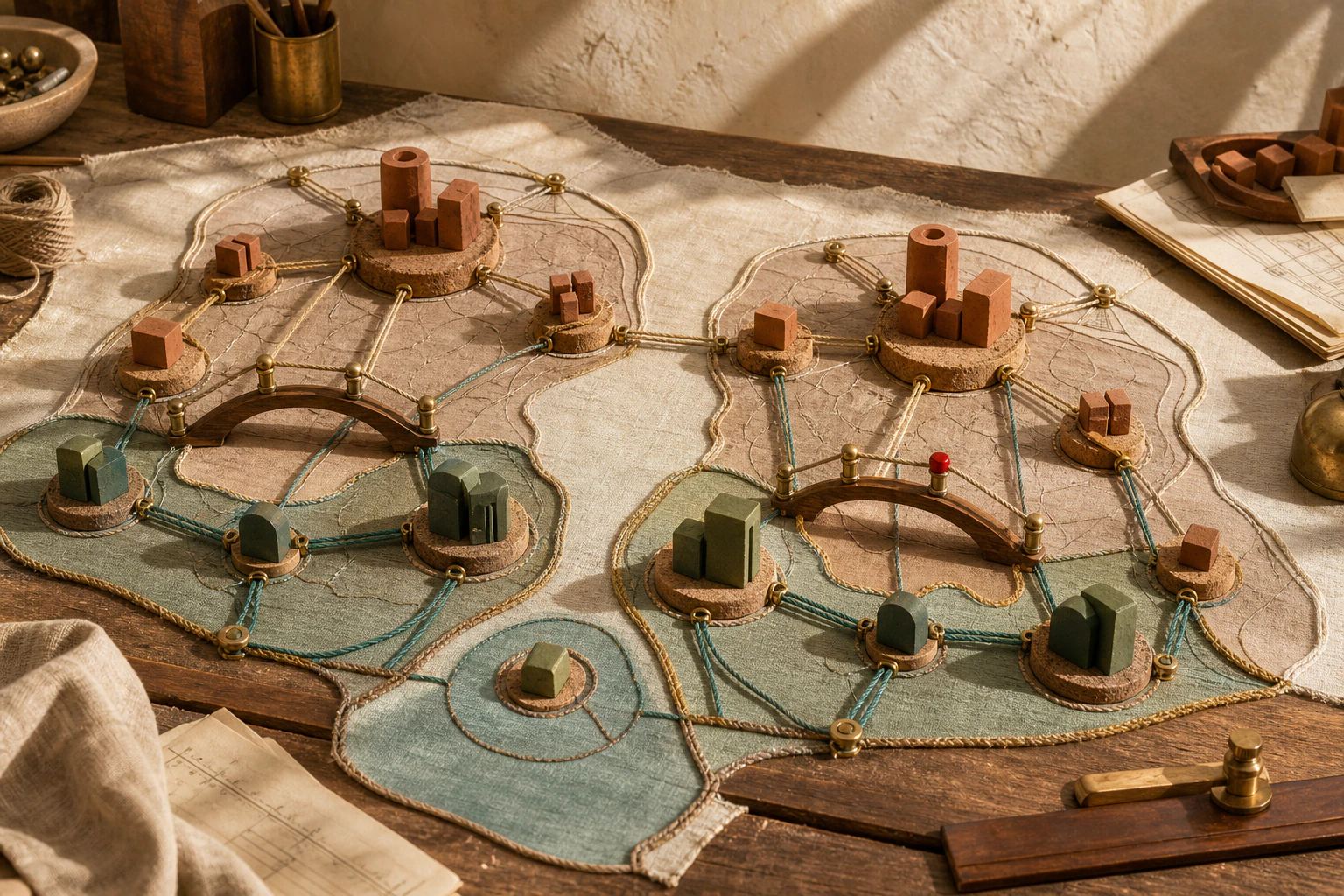
Configuration drift is usually presented as a difference between an expected value and an actual value. That identifies change, but not consequence. A security-group rule, route, IAM policy, or queue subscription matters because of the resources and customer paths it connects. Drift becomes actionable when teams can see its topology.
Table of contents
- Why field-level differences are insufficient
- Declared, actual, and observed state
- From property drift to relationship drift
- Security-group example
- Route example
- IAM example
- Queue-subscription example
- Understanding topology consequences
- Preserving temporal context
- Controlling false positives
- Prioritizing drift
- Remediation considerations
- A practical topology-aware workflow
- Trade-offs and limitations
- Key takeaways
- Frequently asked questions
Why field-level differences are insufficient
Suppose a tool reports:
Security group
sg-1234: ingress rule10.20.0.0/16 TCP 5432added.
The diff is precise. Yet the operational questions remain unanswered:
- Which interfaces use the group?
- Which database or service is reachable on that port?
- Which workloads originate in the CIDR?
- Is the route between networks active?
- Was the rule an emergency repair or an accidental change?
- Does infrastructure as code omit the rule?
- Has runtime traffic used the new path?
- Which owner should decide whether to keep it?
- What breaks if it is removed?
A field diff is an observation about configuration. Topology connects it to resources, relationships, failure domains, trust boundaries, and business capabilities.
This matters because the same textual change can have radically different consequences. Opening port 443 between two isolated test subnets may be low risk. Opening database access from a shared production network may create a significant security path. Removing a route from an unused subnet may be harmless. Removing a route used by payment callbacks can stop a customer journey.
Traditional drift detection remains essential. AWS CloudFormation, for example, can compare supported resources’ actual property values with expected values defined in a stack template. AWS documentation notes important boundaries: support varies by resource type, and expected values used for drift detection depend on properties explicitly set in the template or parameters. A broader operational analysis should preserve those facts rather than assuming “in sync” means “architecture matches every intention.”
Declared, actual, and observed state
Topology-aware drift begins by separating three forms of state.
Declared state
Declared state is what an authoritative definition intends:
- Terraform configuration
- CloudFormation templates
- Kubernetes manifests
- Policy-as-code
- Network design rules
- Service-catalog declarations
It expresses a desired configuration but may be incomplete. Defaults, external resources, manual processes, and runtime-created objects can remain outside the declaration.
Actual state
Actual state is what the cloud control plane reports now:
- Resource configuration
- Attachments
- Routes
- Policies
- DNS records
- Queue subscriptions
- Encryption settings
- Deployment revisions
Actual state is still an observation. APIs can be eventually consistent, permission-scoped, throttled, or unavailable. Keep collection time and coverage.
Observed state
Observed state describes behavior:
- Network flows
- Distributed traces
- Metrics
- Logs
- DNS queries
- Authentication events
- Queue deliveries
- Application-level calls
Observed behavior can validate that a configured path is used, reveal an undeclared dependency, or show that a declared path is dormant. It is never complete: sampling, retention, traffic patterns, and instrumentation affect coverage.
The three states can agree or disagree. A route may be declared and actual but unused. A runtime call may occur through configuration created manually and absent from code. A template may declare a queue subscription that failed to deploy. Do not collapse them into a single Boolean.
Use language such as:
- Declared and present
- Present but undeclared
- Declared but absent
- Observed without a matched declaration
- Declared and present, but no recent observation
- Contradictory evidence
These states are more informative than “drifted.”
From property drift to relationship drift
Property drift compares values. Relationship drift compares the topology implied by those values.
A changed field can:
- Create a new edge
- Remove an edge
- Redirect an edge
- Broaden an edge’s scope
- Narrow an edge’s scope
- Change edge semantics
- Change confidence in an inferred edge
- Change a failure domain
For example, updating a Lambda environment variable from one queue URL to another redirects a PUBLISHES_TO relationship. Adding an IAM action broadens a CAN_ACCESS relationship. Changing a DNS record redirects RESOLVES_TO. Attaching a security group creates a new policy context for a network interface.
A relationship-drift record should include:
- Before and after endpoints
- Relationship type
- Effective time
- Source change
- Declared-state comparison
- Observed runtime evidence
- Affected dependency paths
- Ownership
- Criticality
- Confidence
This lets teams evaluate consequence rather than reviewing every field equally.
Relationship drift also captures changes that no single resource diff reveals. If an application is moved to a different subnet while routes remain unchanged, reachability may disappear through the combination. If a role is attached to a new workload, existing policy statements acquire a new principal context. The topology changed even though each property appears individually valid.

Security-group example
Consider a hypothetical production environment:
- Checkout tasks run in private application subnets.
- An Aurora cluster uses a database security group.
- The database group allows port 5432 from the checkout security group.
- A break-glass maintenance role can modify network controls.
During an incident, an engineer adds a CIDR ingress rule to the database group so a temporary diagnostic host can connect.
Field-diff view
The system reports one added ingress rule. A policy might label it noncompliant because the template does not contain it.
Topology view
A topology-aware analysis asks:
- Which interfaces and clusters use the group?
- Which subnets are included in the CIDR?
- What routes connect those subnets?
- Which workloads can originate traffic there?
- Does an NACL or host policy constrain the path?
- Has traffic been observed?
- Which critical data store is exposed?
- Was there an approved change or incident?
The new rule may create potential paths from several workloads, not only the diagnostic host. If the CIDR covers a shared operations network, the blast radius of compromise expands.
Removal is also a topology change
Automatically removing the rule may break the active diagnostic or recovery path. A safe remediation plan should show who added it, the incident context, last observed use, intended expiry, and affected connections. Human approval remains necessary.
This example demonstrates why severity cannot be derived from “one changed line.” The line changes a reachability graph.
Route example
Routes determine potential traffic paths. A route-table diff might show a target changed from a transit gateway to a NAT gateway, a more-specific prefix added, or a route removed.
Hypothetical scenario
An application subnet uses a route to reach a private service in another VPC. A manual change adds a more-specific route to a different transit attachment.
At the resource level, both routes are syntactically valid. At the topology level, longest-prefix matching redirects only one destination range. The application may continue reaching most services while requests to an identity endpoint fail.
Analysis should combine:
- Subnet-to-route-table association
- Destination prefix
- Route precedence
- Target state
- Transit or peering attachments
- Security groups
- Network ACLs
- DNS resolution
- Observed flows
- Workload-to-endpoint dependency
A route is not proof of connectivity. The reverse path and security controls matter. Conversely, an absent flow log does not prove a route is unused if logging coverage or traffic window is incomplete.
Relationship drift could be expressed as:
checkout-service REACHES identity-servicechanged from confirmed to contradicted after the effective route redirected the destination prefix.
That statement gives responders more context than the route-table line alone.
IAM example
IAM drift is especially sensitive to context. A policy statement defines potential authorization, but effective access depends on identity policies, resource policies, permission boundaries, service control policies, session policies, trust policies, conditions, and the resource being accessed.
Hypothetical scenario
A deployment role receives permission to call kms:Decrypt on a key used by production database backups. The changed policy document is visible as a diff.
Topology questions include:
- Which principals can assume the role?
- Do trust-policy conditions constrain them?
- Which workloads use the role?
- Which resources are encrypted by the key?
- Do organization policies or boundaries deny the action?
- Has the role called the action?
- Is the permission necessary for recovery?
The change creates a potential CAN_DECRYPT path. It may be legitimate recovery enablement, excessive privilege, or ineffective permission blocked elsewhere.
Do not label potential access as observed access. Model both:
MAY_ACCESS, derived from policy evaluation and conditionsOBSERVED_ACCESS, derived from audit events
CloudTrail records can help identify relevant API activity, but logging scope and event type matter. A missing event is not proof that permission is unused.
IAM topology is also temporal. A role may briefly gain privilege and lose it before the next periodic snapshot. Event ingestion can preserve that interval for investigation.
Queue-subscription example
Asynchronous relationships are often omitted from architecture diagrams even though they carry important customer workflows.
Imagine an SNS topic that publishes order events to:
- An SQS fulfillment queue
- An analytics queue
- A partner-notification Lambda function
A manual update changes the fulfillment subscription filter policy. The queue and topic remain healthy. No obvious infrastructure alarm fires.
Diff view
The filter value changed from eventType=["OrderCreated"] to eventType=["OrderUpdated"].
Topology view
The DELIVERS_TO relationship changed semantics. New orders no longer enter fulfillment, while updates do. The application continues creating orders successfully, so customer-facing checkout may appear healthy until fulfillment delay becomes visible.
Analysis should connect:
- Publisher
- Topic
- Subscription
- Filter policy
- Queue
- Consumer
- Dead-letter destination
- Customer capability
- Event schema
- Runtime delivery evidence
The impact unfolds over time. Queue metrics may show fewer messages, not an obvious failure. Business event counts or trace linkage may reveal the missing relationship.
Remediation should restore the intended filter, validate delivery using a controlled event, inspect missed events, and determine replay. Simply changing the value back does not recover lost processing.
Understanding topology consequences
After turning changes into relationship deltas, evaluate their consequences.
Reachability
Did a network, DNS, or authorization path appear or disappear?
Dependency propagation
Which upstream workloads rely on the changed relationship? Traverse typed dependencies, not every graph edge.
Shared-resource exposure
Does the change affect a resource used by multiple workloads or tenants?
Failure-domain change
Did two formerly independent components begin sharing a subnet, cluster, key, or Region?
Security-boundary change
Did trust cross an account, environment, network, or data-classification boundary?
Recovery-path change
Did a change remove access, artifacts, replication, or routing required for recovery?
Customer-impact path
Which business capabilities and journeys depend on the affected workload? Is impact immediate, delayed, or only potential?
Topology consequences should cite the path. “High risk” is insufficient. A useful finding might say:
The new route redirects traffic from the production application subnet to a transit attachment that has no return route. The identity-service dependency is used by login and checkout. Runtime flows were observed on the prior path during the last hour.
This is reviewable and actionable.

Preserving temporal context
Drift is an event and a state. Teams need both.
State answers: “Does the resource currently match its declaration?”
History answers:
- When did it diverge?
- Who or what changed it?
- What was the previous topology?
- Was it temporary?
- Which incident or deployment was active?
- Did runtime behavior change afterward?
- Has the same drift recurred?
Store valid-time intervals for resource properties and relationships. Join them with audit events and deployment records. CloudTrail Event history provides recent management events, but its default view has time, account, Region, and event-type limitations. Long-term analysis requires deliberate trails or another event store.
Time prevents a common investigation mistake: applying today’s topology to yesterday’s incident. If a queue subscription was repaired after an outage, a current snapshot hides the broken path. A temporal graph reconstructs the relationship that existed during the incident.
Time also helps distinguish emergency work from abandoned drift. A manually added rule with an approved one-hour expiry should prompt follow-up when it remains after the incident.
Controlling false positives
Drift tools lose trust when they generate findings without context.
Common false-positive sources include:
- Provider defaults absent from declarations
- Computed or reordered values
- Unsupported resource properties
- Autoscaling and controllers
- Intentional emergency changes
- Environment-specific overrides
- Data-source timing
- Eventual consistency
- Collector permission gaps
- Resource replacement
- Equivalent policy forms
Normalize values before comparison. Treat unordered sets as sets. Record provider defaults separately. Understand which properties are authoritative and which are controller-managed.
Do not treat a failed collection as mass drift. Track coverage and freshness. If a Region API is unavailable, preserve the last known state and mark uncertainty.
Use suppression carefully. A suppression should include scope, owner, reason, expiry, and approval. Permanent global ignores can hide future material changes.
Combine signals. A property mismatch with no topology consequence may remain low priority. A small property change that opens a critical path should escalate.
User feedback can improve inference rules. Preserve rejections and confirmations as evidence rather than deleting source observations.
Prioritizing drift
Prioritization should consider:
- Criticality of affected workload
- Number and type of dependency paths
- Security-boundary crossing
- Customer-facing capability
- Data sensitivity
- Shared-resource centrality
- Recovery impact
- Runtime use
- Change recency
- Confidence
- Existing approval
- Reversibility
Keep likelihood and impact separate. A confirmed tag mismatch may be low impact. A tentative new cross-account access path may warrant urgent review because potential impact is high.
Group related diffs into one architectural change. An infrastructure deployment may update a security group, route, role, and service endpoint together. Four isolated alerts obscure the intended transition.
Provide owner-oriented views:
- “Drift affecting checkout”
- “Unapproved security paths”
- “Recovery environment divergence”
- “Runtime dependencies absent from code”
- “Declared dependencies not observed”
This is more useful than a global list sorted by timestamp.
Remediation considerations
Automated reconciliation is attractive: apply code and restore declared state. It can also break production when the declaration is stale or a manual change is supporting an incident.
Before remediation, answer:
- Is the declared state authoritative?
- Is the diff current?
- Which topology paths will change?
- What active traffic uses them?
- Is the drift intentional?
- What is the rollback?
- Who owns affected workloads?
- What validation proves success?
A controlled plan should include evidence, blast radius, prerequisites, action, validation, rollback, and approval.
For the queue-filter example, remediation must address both configuration and missed business events. For the route example, validate forward and reverse connectivity. For IAM, evaluate effective access and monitor relevant activity. For a security group, confirm consumers before removing access.
Separate read-only discovery from remediation privileges. A platform that analyzes drift does not need unrestricted write access. Use narrowly scoped execution roles, policy controls, short-lived sessions, audit logs, and human approval for production-impacting actions.
A practical topology-aware workflow
1. Identify authoritative declarations
Map resources to CloudFormation, Terraform, policy repositories, or other sources. Record where no declaration exists.
2. Collect actual state safely
Use read-only, least-privilege discovery. Record account, Region, collection time, and errors.
3. Normalize identities and values
Resolve canonical resource identities and aliases. Normalize sets, defaults, and provider representations.
4. Generate property differences
Preserve before and after values, declaration source, and resource support limitations.
5. Translate differences into relationship changes
Use typed rules: route changes affect reachability; queue filters affect delivery; IAM changes affect potential authorization.
6. Enrich with observed behavior
Add current telemetry where available. Label coverage and freshness.
7. Traverse impact
Find affected workloads, owners, customer capabilities, security boundaries, and recovery paths.
8. Rank and group
Group changes by deployment or event. Rank using impact, evidence, recency, and approval status.
9. Review and remediate
Present an evidence-backed plan with validation and rollback. Require appropriate approval.
10. Preserve history
Retain the drift interval, decision, action, and outcome. Use recurring patterns to improve controls.
Trade-offs and limitations
Topology-aware analysis requires more data and domain modeling than property comparison. Runtime telemetry can be expensive and incomplete. Identity resolution can be ambiguous. Business context can be stale. Temporal history increases storage and query complexity.
Not every relationship can be inferred safely. External APIs, manual operations, and application logic may remain invisible. Display confidence and allow human validation.
Coverage should be communicated at the same level as every finding. A topology result built from two connected accounts must not be presented as organization-wide. Likewise, an analysis that includes network configuration but excludes application traces should describe possible reachability, not confirmed runtime use. Teams benefit from a compact evidence panel that lists connected accounts, scanned Regions, supported resource classes, the latest successful collection, telemetry window, and unresolved permissions. That context turns a confident-looking diagram into an auditable operational artifact.
There is also a modeling trade-off between consolidation and fidelity. Combining several evidence records into one DEPENDS_ON edge makes visualization simpler, but it can hide whether the dependency was configured, permitted, or observed. Keeping every source as a separate visible edge can overwhelm users. A practical design retains granular evidence underneath a consolidated relationship while allowing engineers to expand the sources, disagreements, and validity intervals. The interface stays usable without discarding the distinctions needed for safe remediation.
Provider-native drift detection has valuable, documented scope. Extending it should not produce false claims of complete coverage. State which resource types, properties, accounts, Regions, and time windows are represented.
Finally, topology itself is sensitive. Dependency and security-path data requires tenant isolation, access control, minimization, retention, and auditability.
Key takeaways
- A field diff identifies change; topology explains consequence.
- Keep declared, actual, and observed state separate.
- Property changes create, remove, redirect, or reshape relationships.
- Security groups, routes, IAM, and queue filters require different semantics.
- Temporal history is essential for incident reconstruction.
- Context controls false positives and improves prioritization.
- Drift severity depends on affected paths, not line count.
- Remediation should evaluate active dependencies, rollback, and evidence.
- Read-only discovery and controlled execution should use separate permissions.
Frequently asked questions
Is CloudFormation drift detection enough for topology analysis?
It is an important input for supported CloudFormation resources and properties. Topology analysis additionally connects changes to runtime evidence, resources outside a stack, cross-stack relationships, ownership, customer capabilities, and time.
Does observed traffic prove a dependency is required?
It proves that traffic occurred during the observation window, subject to telemetry coverage. It does not prove that the path is always required. Combine runtime evidence with configuration, application knowledge, and validation.
Should every drift finding be remediated?
No. Some drift is intentional, controller-managed, or evidence that code is stale. Review authority, topology impact, runtime use, and rollback before acting.
How does topology reduce false positives?
It filters and ranks differences by their effect on meaningful relationships. It also reveals collection gaps, declared-versus-observed distinctions, and approved temporary changes.
Can this process operate without write access?
Discovery, comparison, and analysis can be designed around read-only access. Remediation should use a separate, narrowly scoped role with policy controls and human approval.
Conclusion
Cloud configuration drift becomes operational when it is connected to architecture. A changed rule, route, policy, or subscription is important because it changes who can reach what, which workload depends on which path, and how failure or compromise may propagate.
StackScopes treats drift as a temporal topology question. By joining declarations, provider state, runtime evidence, dependency paths, ownership, and customer context, teams can prioritize the changes that matter and plan remediation without hiding uncertainty.
Official references
- AWS CloudFormation drift detection
- AWS CloudFormation resource drift
- How AWS Config works
- AWS CloudTrail event history
- IAM policy evaluation logic
- Amazon VPC route-table concepts
- Amazon SNS subscription filter policies
Related StackScopes reading
Continue exploring
Map the path behind the risk.
Explore cloud topology, failure simulation, blast radius, and evidence-backed recovery with StackScopes.