 StackScopes
Model-based failure simulation and chaos engineering help teams learn how systems behave under stress, but they produce different evidence and expose organizations to different risks. Simulation explores a representation of the system; chaos experiments change real runtime conditions. Mature resilience programs can use both without pretending that one replaces the other.
Table of contents
- Define the two methods
- What each method can prove
- Safety and production risk
- Fidelity and model uncertainty
- Cost and environment requirements
- Observability requirements
- Organizational maturity
- Learning value
- A practical comparison matrix
- Example scenarios
- Combining both methods
- Common mistakes
- An adoption path
- Trade-offs and limitations
- Key takeaways
- Frequently asked questions
Define the two methods
Model-based failure simulation
Model-based failure simulation applies a scenario to a digital representation of infrastructure and dependencies. It does not intentionally stop, throttle, or corrupt production resources.
A simulation can ask:
- What upstream services depend on this database?
- Which paths lose availability if an Availability Zone is assumed unavailable?
- Does a fallback remain?
- Which tenants are mapped to an affected shard?
- How soon does a queue backlog become customer-visible?
- Which recovery order follows from known dependencies?
Inputs may include resource configuration, dependency edges, runtime observations, service ownership, redundancy, recovery objectives, and scenario assumptions. Outputs are reasoned projections, not direct measurements of real failure behavior.
Chaos engineering
Chaos engineering is a disciplined experimental practice that introduces controlled changes or fault conditions into a real system to test a hypothesis about resilience. Experiments can run in an isolated environment or, with appropriate maturity and safeguards, in production.
Examples include:
- Stopping selected instances
- Injecting network latency or packet loss
- Throttling an API
- Terminating tasks
- Disrupting an Availability Zone path
- Exhausting a bounded resource
- Blocking access to a dependency
The objective is not random breakage. A well-designed experiment defines a steady state, hypothesis, scope, safeguards, abort conditions, observations, and recovery.
AWS Fault Injection Service is an official service for running controlled fault-injection experiments on supported AWS workloads. Its existence does not make every experiment safe by default; scope, permissions, stop conditions, monitoring, and organizational readiness still matter.
What each method can prove
Simulation and chaos answer different questions.
A model-based simulation can show what follows from the model:
Given these dependency relationships, redundancy assumptions, and current resource state, a database failure is expected to affect checkout writes, the order event stream, and tenants on shard 2.
That is a conditional conclusion. It is valuable for discovery, design review, and prioritization. It does not prove that application retry logic, connection pools, failover timing, or operational response will behave exactly as expected.
A chaos experiment can observe real behavior under a bounded condition:
When selected application tasks lost network access to the cache, request latency increased, fallback reads reached the database, and the abort threshold triggered after four minutes.
That is empirical evidence for the tested environment, time, traffic, and scope. It does not prove behavior under every future load or fault. It also may not test customer impact if the experiment runs in staging.
Simulation is strong at breadth: many scenarios, shared dependencies, historical topology, pre-change analysis, and paths that would be unsafe to disrupt.
Chaos is strong at runtime validation: retry behavior, timeouts, capacity, alerting, automation, and human response.
Neither proves absolute resilience. Simulation is limited by model fidelity. Experiments are limited by scope and representativeness.
Safety and production risk
Model-based simulation is safer because it operates on a representation. A team can explore loss of a production database, key, Region, or identity path without creating the failure. This makes it suitable for early discovery and high-consequence scenarios.
Its risk is primarily decision risk: an inaccurate model can produce misleading conclusions. If a team treats projections as proven behavior, it may trust a fallback that does not work.
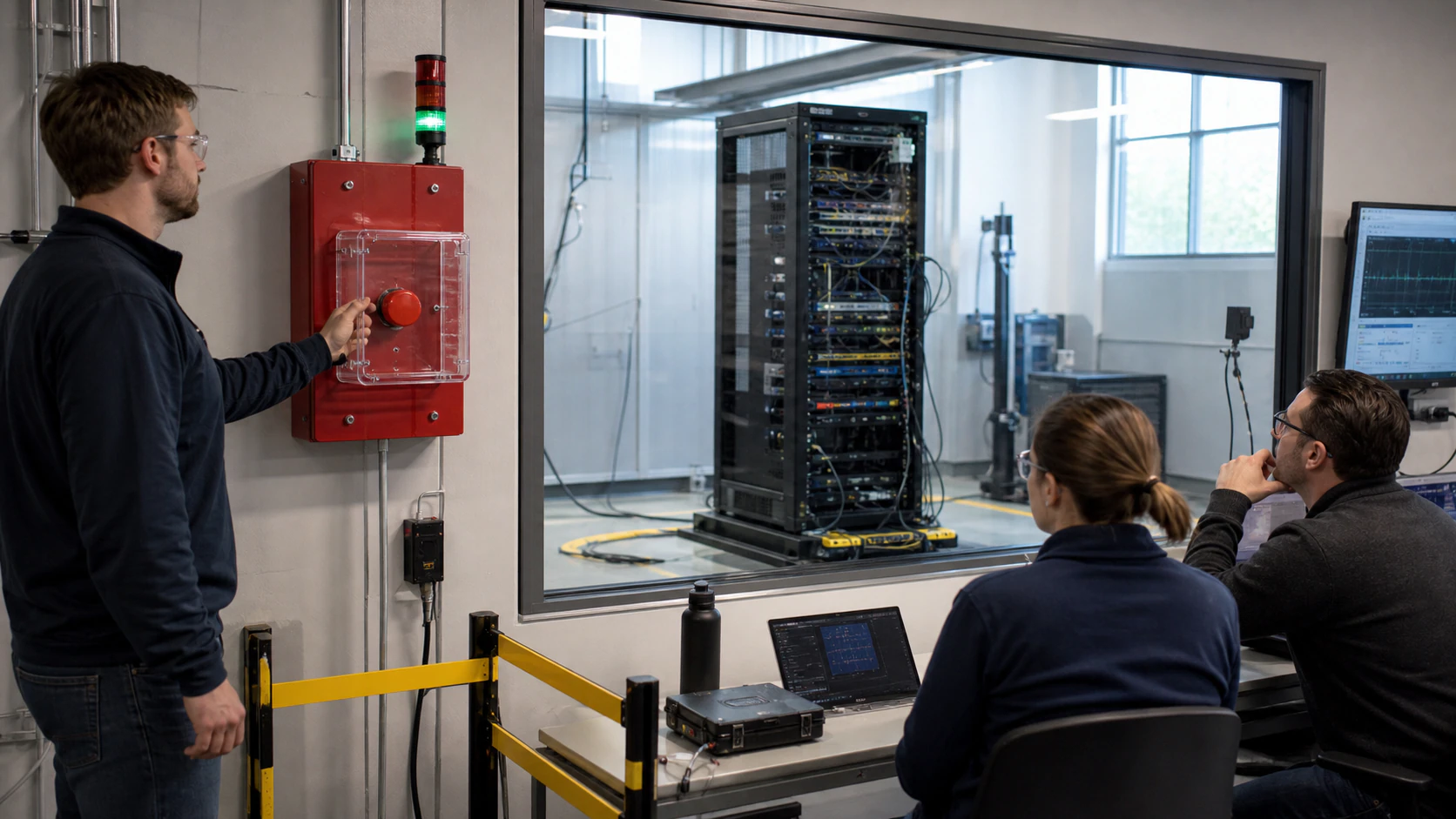
Chaos engineering creates runtime risk. Even a carefully scoped experiment can propagate through hidden dependencies, trigger automated remediation, exhaust capacity, or affect customers. The practice therefore needs:
- Explicit hypothesis
- Bounded blast radius
- Appropriate environment
- Stakeholder approval
- Least-privilege experiment role
- Stop conditions
- Monitoring
- Rollback or recovery method
- Change freeze awareness
- Incident escalation
- Data-protection controls
Production experimentation can provide strong evidence, but production is not the starting point for an immature program.
Safety is not binary. A simulation that automatically executes a recommended action is no longer merely a simulation. A chaos experiment in an isolated disposable environment has much lower customer risk than one against a shared production dependency.
Keep analysis permissions separate from fault-injection or remediation permissions. A system that discovers topology should not automatically receive unrestricted authority to disrupt resources.
Fidelity and model uncertainty
Fidelity asks how closely the exercise represents real behavior.
Chaos experiments use actual application code, infrastructure, timing, and observability in the selected environment. Production experiments can include real traffic patterns and hidden interactions that models missed. This provides high runtime fidelity for the injected condition.
But fidelity has boundaries:
- Staging may differ from production scale.
- A short experiment may miss delayed effects.
- A small fault may not represent a regional event.
- Test traffic may not represent customers.
- Safety controls can prevent full propagation.
- The system may change after the experiment.
Simulation fidelity depends on inputs and rules:
- Current resource inventory
- Correct dependency identity
- Edge semantics
- Runtime evidence coverage
- Redundancy model
- Failure propagation rules
- Capacity assumptions
- Time-to-impact assumptions
- Customer mapping
- Temporal accuracy
An explainable simulator should show evidence, confidence, and assumptions. “Database failure affects 17 services” is less useful than a breakdown of runtime-confirmed callers, configured callers, tentative paths, working fallbacks, and stale evidence.
Model calibration is a powerful combined practice. Run a controlled experiment, compare observed behavior with the simulation, then update missing edges, propagation rules, and durations. Over time, simulation becomes more useful, while chaos scenarios become more focused.
Cost and environment requirements
Simulation requires investment in data collection, normalization, dependency inference, temporal storage, and scenario logic. Once the model exists, exploring additional scenarios may be relatively inexpensive and does not require duplicate runtime environments.
Chaos engineering may require:
- Representative staging capacity
- Fault-injection tooling
- Experiment permissions
- Observability
- On-call staffing
- Test data
- Traffic generation
- Recovery time
- Governance and review
Experiments can also consume operational attention. The cost is justified when the hypothesis addresses meaningful uncertainty.
Do not compare only tool licenses. A weak simulation model creates review work; an unsafe experiment creates incident risk. The relevant economic question is which method provides the needed evidence at acceptable risk and effort.
Simulation can screen scenarios. If a graph reveals that a queue is not on any critical path, a high-cost chaos exercise may not be the next priority. If simulation reveals a central identity dependency with an unverified fallback, the finding can justify a carefully staged experiment.
Observability requirements
Chaos engineering depends heavily on observability. Without a steady-state signal and detection of unintended effects, teams are injecting faults without learning safely.
Useful signals include:
- Customer-journey success
- Service-level indicators
- Error rate and latency
- Saturation
- Queue age
- Retry rate
- Data-integrity checks
- Deployment health
- Logs and traces
- Business transaction outcomes
Stop conditions must use timely, reliable signals. If telemetry arrives after a long delay, an automated abort may not protect the system.
Simulation has different observability needs. It can operate with configuration alone, but runtime telemetry improves relationship validation, timing, and criticality. It also needs observability about the model:
- Collector freshness
- Account and Region coverage
- Edge provenance
- Last observed runtime call
- Contradictions
- Inference confidence
- Missing ownership
This “observability of the model” prevents false certainty.
Both methods benefit from customer-oriented signals. Resource health alone cannot establish whether a journey works. A chaos test that terminates a task but never checks customer behavior proves only that the task was terminated.
Organizational maturity
The right method depends on operating discipline.
Early-stage teams
Teams with incomplete ownership, limited observability, and fragile change processes should begin with inventory, dependency mapping, model-based scenarios, and tabletop exercises. These reveal hidden scope without intentionally adding runtime faults.
Developing teams
Once critical journeys, alerts, ownership, and recovery procedures are credible, teams can run component experiments in isolated environments. Start with reversible, small-scope hypotheses.
Mature teams
Teams with strong service-level signals, automated rollback, well-defined incident command, and tested resilience can consider broader or production experiments. Production use still needs approval and bounded scope.
Maturity is capability-specific. A company may be mature at stateless compute experiments and immature at data corruption scenarios. Do not issue one organization-wide “chaos ready” label.
Culture matters. Experiments should improve systems, not evaluate individual engineers. Blameless review encourages reporting unexpected behavior. If teams fear punishment, they will avoid meaningful tests or hide failures.
Learning value
Simulation supports:
- Architecture review
- Hidden-dependency discovery
- Blast-radius estimation
- Pre-change analysis
- Historical incident reconstruction
- Recovery-order planning
- Scenario prioritization
- Cross-team workshops
Chaos supports:
- Runtime validation
- Timeout and retry testing
- Capacity and fallback behavior
- Alert testing
- Automation validation
- Operator practice
- Recovery-duration measurement
- Discovery of emergent effects
The methods generate different artifacts. Simulation produces paths, assumptions, predicted impact, and evidence. Chaos produces experimental observations, telemetry, actual response, and measured recovery. Store both and link them.
Negative results are valuable. If an experiment disproves a simulation, the model improves. If simulation uncovers an unsafe blast radius, it may prevent a poorly scoped experiment.
Practical comparison matrix
| Dimension | Model-based failure simulation | Chaos engineering | |---|---|---| | Acts on runtime systems | No intentional runtime fault | Yes, within experiment scope | | Primary output | Projected propagation and impact | Observed behavior under injected conditions | | Safety | High operational safety; model-decision risk remains | Runtime risk requires controls | | Breadth | Efficient across many hypothetical scenarios | Usually narrower per experiment | | Fidelity | Depends on model, evidence, and assumptions | High for tested condition and environment | | Hidden behavior | May miss unknown runtime paths | Can reveal emergent runtime behavior | | Environment need | Digital model and evidence sources | Representative environment and experiment controls | | Observability | Needed for model coverage and enrichment | Essential for hypothesis and abort conditions | | Best early use | Discovery, prioritization, tabletop planning | Small isolated component tests | | Production use | Analysis can use production model safely | Requires high maturity and approval | | Historical use | Can simulate against preserved past topology | Cannot recreate every past state directly | | Recovery evidence | Proposed order and prerequisites | Measured execution and behavior |
The table describes tendencies, not guarantees. A poor simulation may have low value; a disciplined staging experiment may be extremely safe.
Example scenarios
Scenario 1: database writer failure
Simulation approach: Remove the writer node from the modeled topology. Traverse typed WRITES_TO relationships, identify read-only fallbacks, map affected journeys, estimate time-to-impact from retries, and propose dependency-aware recovery order.
What it learns: potential blast radius, owners, shared dependencies, and recovery prerequisites.
Chaos approach: In an approved environment, initiate a bounded failure or connectivity disruption. Observe driver failover, connection-pool behavior, retry storms, write errors, alarms, and recovery duration.
What it learns: actual application and operational response.
Best combined use: simulate first to establish scope; test in isolation; compare observed behavior with the model.
Scenario 2: cache loss
Simulation approach: Assume the cache is unavailable. Identify services using it and the databases that receive fallback load. Use capacity assumptions to flag possible secondary saturation.
Chaos approach: Block cache access for selected application instances. Observe latency, database load, stampede protection, and customer-journey success.
Simulation may predict the path but cannot precisely reproduce concurrency and cache stampede behavior without a detailed performance model. Chaos provides empirical evidence.
Scenario 3: Availability Zone impairment
Simulation approach: Mark resources in one zone unavailable. Check whether load balancers, compute, databases, NAT paths, and queues retain independent capacity. Identify resources unintentionally concentrated in one zone.
Chaos approach: Use supported fault-injection mechanisms or targeted network controls in a carefully bounded environment. Observe placement, scaling, failover, and control-plane behavior.
A model is particularly useful before attempting this broader experiment because it can reveal hidden shared dependencies.
Scenario 4: security-group change
Simulation approach: Apply a proposed configuration diff to the graph and calculate reachability changes. Identify lost dependencies and new security paths.
Chaos approach: In a nonproduction or approved canary scope, apply the change and run synthetic journeys.
This is also change-impact testing. The combined workflow can prevent a full rollout when predicted topology shows a critical loss.
Scenario 5: regional loss
Simulation approach: Remove regional nodes, preserve global dependencies, and evaluate recovery-region prerequisites, data replication, identity, DNS, artifacts, and customer routing.
Chaos approach: A literal regional shutdown is rarely an appropriate direct experiment. Teams can test selected components: recovery-region deployment, backup restore, traffic shift, and isolated service behavior.
Simulation handles the broad hypothetical; exercises validate feasible parts.
Combining both methods
A strong workflow is:
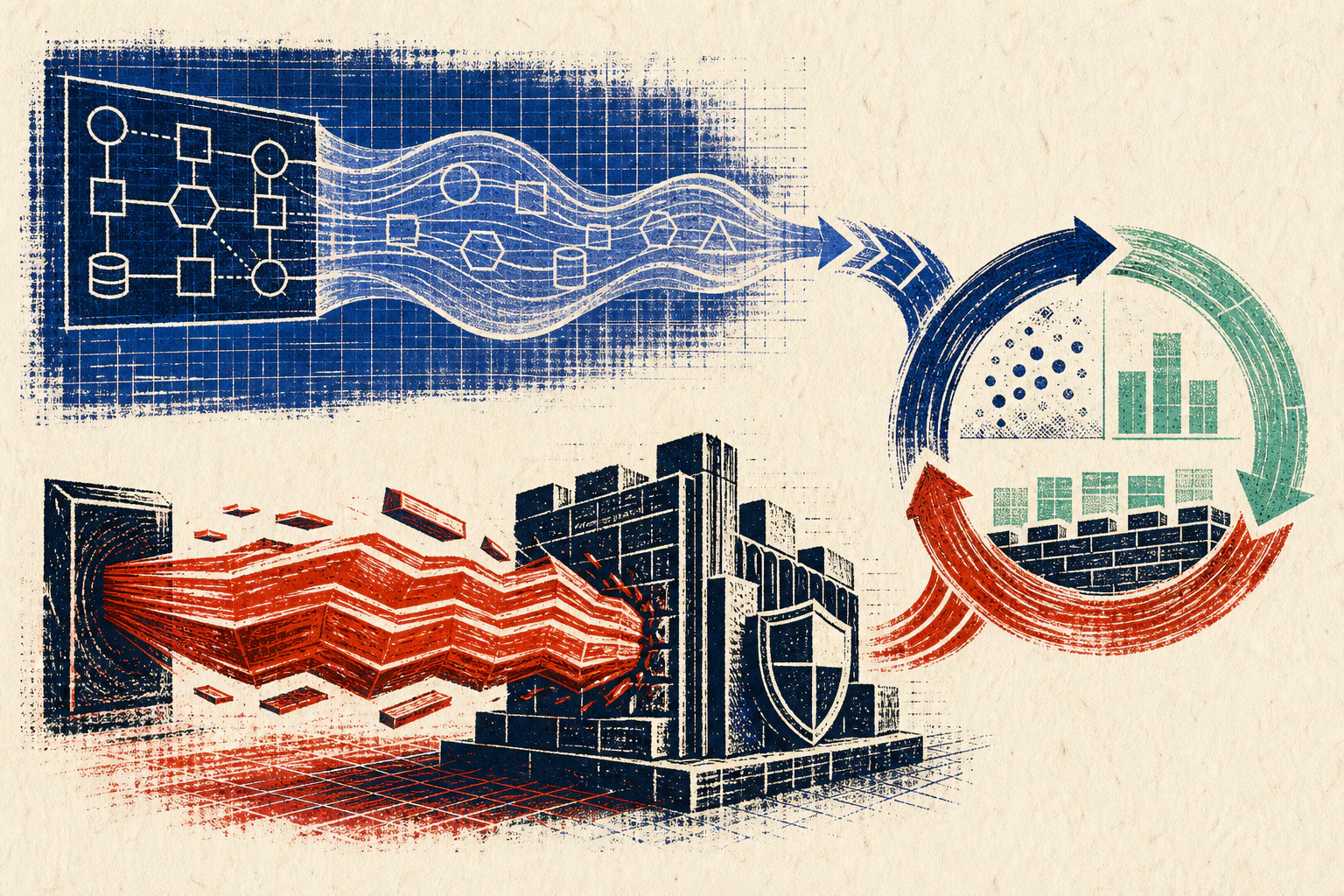
Discover → Model → Simulate → Prioritize → Experiment → Compare → Improve
Discover
Collect read-only cloud configuration, infrastructure declarations, audit events, ownership, and selected telemetry.
Model
Build a temporal dependency graph with typed edges, evidence, confidence, and criticality.
Simulate
Define a failure mode and assumptions. Produce predicted paths, customer impact, time-to-impact, and recovery options.
Prioritize
Choose experiments where uncertainty and consequence justify runtime validation.
Experiment
Write a hypothesis, steady-state definition, scope, safeguards, stop conditions, and recovery plan. Use least-privilege permissions.
Compare
Map observed behavior to predictions. Identify missing dependencies, incorrect redundancy assumptions, timing differences, or inadequate telemetry.
Improve
Update graph evidence, propagation rules, runbooks, architecture, and experiment design. Preserve history.
This creates a learning loop. Simulation avoids blind experimentation; chaos prevents the model from becoming an untested theory.
Common mistakes
Treating simulation as proof
A simulation reports what follows from known data and assumptions. Label projected impact and confidence.
Treating chaos as random failure
An experiment needs a hypothesis and bounded scope. Random disruption without learning objectives is unsafe.
Starting in production
Production experiments require mature observability, controls, ownership, and recovery. Build capability progressively.
Testing resources instead of journeys
Stopping a node proves little unless the team observes service and customer outcomes.
Ignoring data integrity
Availability tests can create duplicates, lost writes, or inconsistent state. Include integrity checks.
Overlooking automated side effects
Autoscaling, failover, remediation, and alarms may amplify an injected fault. Model and monitor them.
Using one tool for every failure mode
Some scenarios are best explored through simulation, some through component tests, and some through tabletop exercises.
Hiding model uncertainty
Show source coverage, stale evidence, confidence, and contradictions.
Ending at the report
The learning should change architecture, alerts, runbooks, or the model. Otherwise resilience does not improve.
An adoption path
Phase 1: establish context
Define critical journeys and owners. Inventory resources and map major dependencies. Identify recovery objectives and basic fallbacks.
Phase 2: run model-based reviews
Simulate high-consequence node failures and changes. Review blast radius and uncertain paths with service owners.
Phase 3: strengthen observability
Define steady-state signals, synthetic tests, data-integrity checks, and experiment abort conditions.
Phase 4: test isolated components
Run reversible experiments in development or isolated environments. Measure actual timeouts, retries, alerts, and recovery.
Phase 5: calibrate
Compare observations with model predictions. Improve dependency rules, capacity assumptions, and runbooks.
Phase 6: expand carefully
Increase scope only when evidence supports it. Production experiments require explicit organizational authority and safeguards.
Phase 7: govern continuously
Review scenarios after architecture changes and incidents. Version experiments and link them to topology state.
Trade-offs and limitations
Simulation breadth comes at the cost of abstraction. Accurate performance modeling, application logic, and human behavior can be difficult. Chaos fidelity comes at the cost of runtime risk and limited scenario scope.
Both depend on time. Architecture changes can invalidate last month’s model and last quarter’s experiment. Preserve dates, versions, and environment details.
The evidence produced by either method can also be misread. A simulation path is not an outage forecast, and a successful experiment is not a permanent certification. Workload behavior depends on traffic, data shape, deployment version, capacity, feature flags, and external services. Every result should state the tested or modeled scope, observation window, scenario, assumptions, and acceptance criteria.
Teams should resist turning exercise volume into a maturity metric. Running many low-value experiments or simulations can create activity without reducing meaningful uncertainty. Prefer a smaller portfolio tied to critical journeys, recurring incidents, major changes, or unverified recovery paths. Record what decision each scenario informs and what engineering change followed.
Data protection can constrain both approaches. A simulation graph may contain sensitive architecture, tenant placement, and identity relationships. An experiment may expose or alter real records. Use minimum necessary data, access boundaries, safe test tenants, audit trails, and retention policies. Do not copy production data into a test environment merely to increase fidelity without a reviewed protection strategy.
Experiment tooling adds another failure surface. Stop conditions can fail, observability may lag, and automated recovery can interact with autoscaling or deployment controllers. Test safeguards before testing the workload. For broad scenarios, use staged scope and independent monitoring so the same fault does not disable the mechanism meant to detect it.
External dependencies impose a further boundary. A team can model a payment provider or simulate its unavailability, but it may not have authority to inject faults into the provider. Contractual test endpoints, local stubs, and controlled network denial can validate selected behavior without disrupting another organization. Record where the exercise stops and which provider assumptions remain unverified.
Tools do not create resilience culture. Teams need ownership, learning-oriented reviews, and authority to fix findings.
Some experiments may be inappropriate because customer, regulatory, safety, or data-integrity consequences are too high. Simulation, formal review, and isolated recovery exercises remain valuable alternatives.
Key takeaways
- Simulation projects behavior from a model; chaos observes behavior under controlled runtime faults.
- Neither method proves universal resilience.
- Simulation offers breadth and safety; chaos offers empirical runtime evidence.
- Safety, fidelity, cost, observability, and maturity determine the right choice.
- Use simulation to scope and prioritize experiments.
- Use experiments to calibrate the model.
- Test customer journeys and data integrity, not just resource health.
- Separate discovery permissions from fault-injection permissions.
- Production experimentation is an advanced practice, not a default.
Frequently asked questions
Does failure simulation replace chaos engineering?
No. Simulation is useful for broad, safe exploration and planning. Chaos validates selected runtime behavior. The methods are complementary.
Must chaos experiments run in production?
No. Useful experiments can run in isolated or staging environments. Production can improve representativeness but requires stronger safeguards and organizational maturity.
How accurate is a model-based simulation?
Accuracy depends on resource coverage, dependency semantics, runtime evidence, temporal freshness, and propagation assumptions. Results should show evidence and uncertainty.
What should teams simulate first?
Start with a critical workload and a small set of high-consequence dependencies: database, identity, DNS, queue, cache, or shared network path. Choose scenarios that answer a decision.
How can an experiment improve a digital twin?
Compare observed calls, failures, timing, fallbacks, and customer outcomes with predictions. Add missing edges, correct assumptions, and attach experiment evidence to the model.
Conclusion
The debate between failure simulation and chaos engineering is a false choice. They answer different questions. Simulation lets teams explore the architecture they believe they operate. Chaos lets them observe selected behavior in the system they actually run.
StackScopes emphasizes model-based simulation because teams need a production-safe way to understand dependency paths, blast radius, and recovery before taking action. Where controlled experiments are appropriate, their evidence can refine the digital twin and strengthen future decisions.
Official references
- AWS Fault Injection Service User Guide
- AWS FIS safety and best practices
- AWS Well-Architected Reliability Pillar
- AWS Well-Architected: conduct game days
- AWS Well-Architected: disaster recovery planning
Related StackScopes reading
Continue exploring
Map the path behind the risk.
Explore cloud topology, failure simulation, blast radius, and evidence-backed recovery with StackScopes.