 StackScopes
Cloud teams rarely lack data. They lack a dependable model that explains how thousands of pieces of data relate to the system engineers are responsible for operating. An AWS account can provide resource inventories, configuration histories, metrics, logs, API events, tags, deployment plans, and security findings. Each source is useful, yet none automatically answers the operational question behind an incident or risky change: what depends on this resource, what has changed, and what could be affected next?
A cloud infrastructure digital twin is a practical answer to that context problem. It is a living model of infrastructure state, relationships, and history that can be queried and used for analysis without treating production as an experiment. Unlike a static architecture diagram, it changes when the environment changes. Unlike a conventional inventory, it represents dependencies. Unlike a monitoring dashboard, it can retain topology and configuration context even when a resource is healthy, deleted, or outside the current alert window.
This article explains what a cloud infrastructure digital twin means in an AWS setting, how it differs from adjacent tools, which data it needs, where simulation fits, and where its limits remain. The goal is not a futuristic metaphor. It is an implementable operating model for teams that need to reason about cloud systems as connected systems rather than isolated resources.
Table of contents
- Why inventory is necessary but insufficient
- What a cloud infrastructure digital twin is
- Inventory, CMDB, diagram, and digital twin
- The five essential dimensions
- A hypothetical AWS environment
- From discovery to a living model
- How the twin supports simulation
- Freshness, confidence, and evidence
- Limits and trade-offs
- A practical adoption path
- Key takeaways
- Frequently asked questions
Why inventory is necessary but insufficient
Inventory answers an important first question: what resources exist? AWS Resource Explorer, AWS Config, service APIs, tags, and asset-management systems can all contribute to that answer. A credible digital twin begins with this discovery work. If a model cannot establish stable resource identity, account, Region, type, and configuration, its later conclusions will be unreliable.
The operational questions faced by platform engineers go beyond existence, however. Consider an Amazon RDS database whose status is “available.” That status does not identify which applications connect to it, whether a failover path has been tested, which security groups and secrets enable access, which dashboards observe it, or which customer-facing capability becomes impaired if database latency rises. The resource is healthy in isolation while the wider system may still contain a fragile dependency.
Inventory also tends to flatten different kinds of information. A load balancer, IAM role, Route 53 record, KMS key, Lambda function, SQS queue, and database may all be items in a list. Their configurations differ, their lifecycles differ, and the relationships among them carry more operational meaning than the count of rows. A list can be filtered, but it cannot naturally express a multi-hop path such as:
public endpoint → load balancer → service → task role → secret → database
That path matters during change review, incident triage, and security analysis. If the task role loses permission to read the secret, the database can remain healthy while the application fails. If the secret rotates incorrectly, a resource-health view can again look deceptively normal. Operational reasoning therefore requires a relationship model, not just a resource catalog.
Inventory is also commonly present-tense. It shows what exists now. Incident investigation often needs to know what existed at 14:05, immediately before a deployment, and how that topology differed from 13:50. A deleted target group or replaced security-group rule may no longer appear in a current snapshot. Without historical state, investigators must reconstruct the system from scattered events while an outage is underway.
The practical conclusion is straightforward: inventory is the foundation, not the finished operational model.
What a cloud infrastructure digital twin is
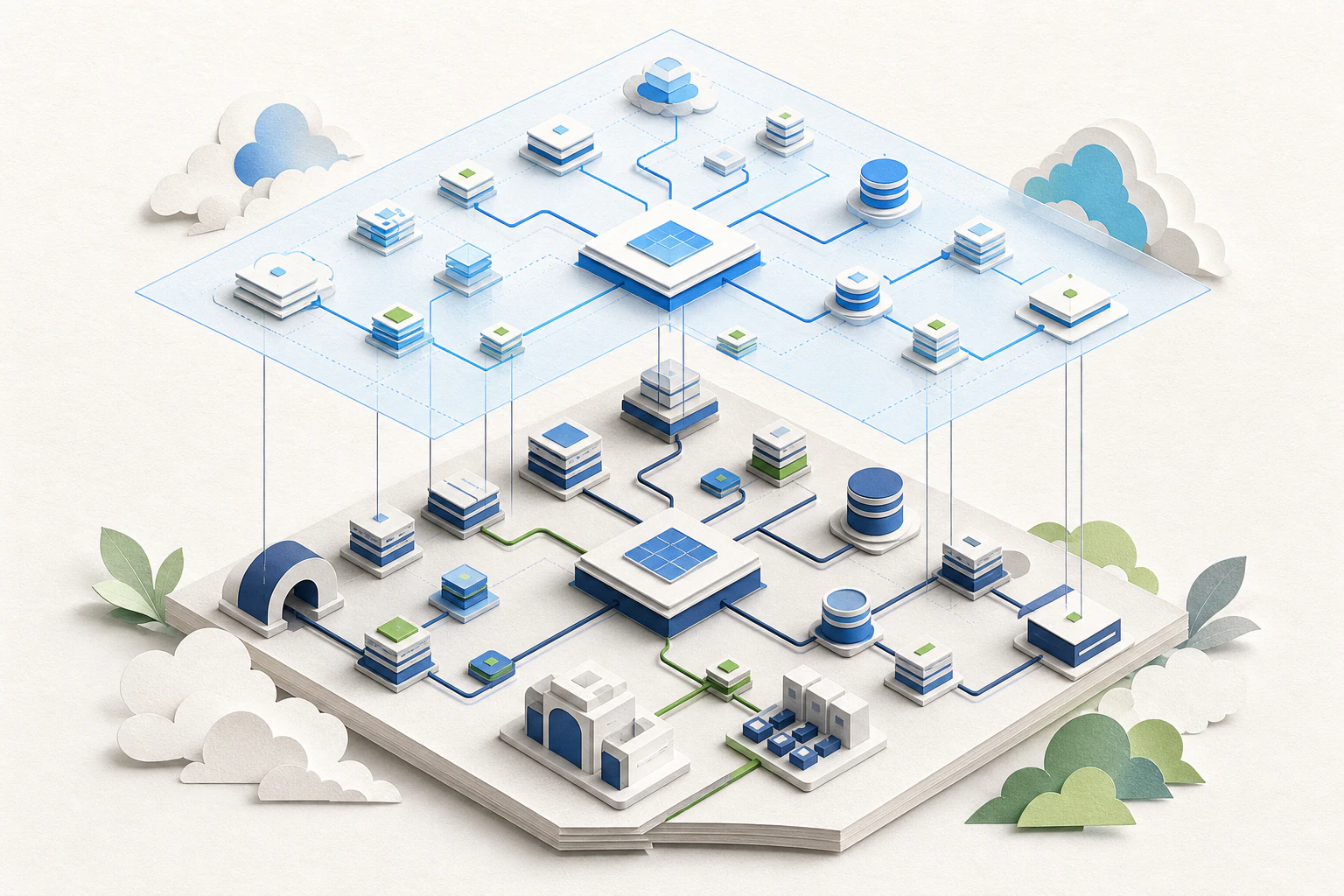
A cloud infrastructure digital twin is a continuously updated representation of cloud resources, their configurations, their relationships, and their evolution over time. It combines observed facts and derived relationships into a graph that supports queries, comparisons, investigations, and model-based simulations.
“Twin” does not mean a perfect copy of every physical or logical behavior. Cloud systems include proprietary service internals, application code, external providers, transient network conditions, and human processes that no infrastructure model can fully reproduce. The useful meaning is narrower: the twin mirrors the operationally relevant structure and state of an environment closely enough to support better reasoning.
A practical twin has several characteristics:
- Resource identity: Every modeled object has a stable identity tied to account, Region, service, and provider identifier where available.
- Normalized state: Service-specific configurations are retained while common attributes are represented consistently.
- Typed relationships: Connections have direction and meaning, such as “routes to,” “assumes,” “encrypts with,” “reads from,” or “is deployed in.”
- Temporal history: State and relationships are associated with observation or validity time.
- Evidence: The model records why a relationship or conclusion exists.
- Confidence: Derived relationships distinguish strong evidence from informed inference.
- Boundaries: Accounts, Regions, environments, teams, and tenants remain visible rather than being merged into an anonymous graph.
- Analysis: The model can answer dependency, change-impact, blast-radius, drift, and investigation questions.
The distinction between facts and inferences is important. An explicit target-group registration is a strong configuration fact. A likely application-to-database dependency inferred from network flow, secret references, and naming context is a reasoned conclusion. Both can be useful, but operators should be able to see which is which.
Inventory, CMDB, diagram, and digital twin
Several existing practices overlap with a cloud digital twin. Understanding the differences prevents teams from renaming an old system without gaining new capability.
Resource inventory
An inventory primarily catalogs objects and attributes. It is excellent for questions such as “which S3 buckets exist in eu-west-1?” or “which EC2 instances lack a required tag?” Inventory usually offers filters, counts, ownership fields, and current configuration. Its weak point is multi-hop operational context.
A digital twin consumes inventory data but connects it into a typed and temporal model.
Configuration management database
A CMDB stores configuration items and relationships, often across cloud and non-cloud estates. In theory, a CMDB can represent many elements of a twin. In practice, some CMDB implementations depend heavily on manual updates, coarse service models, and ticket-driven processes. Their relationship data can lag behind ephemeral infrastructure.
The difference is not the database label. A continuously discovered, evidence-backed, time-aware CMDB could participate in a digital twin. The test is whether the model stays current enough, preserves provenance, and supports the operational questions teams actually ask.
Architecture diagram
An architecture diagram communicates design intent. A well-made diagram is valuable because it compresses complexity for human readers. It may show service boundaries, trust zones, major data flows, and intended redundancy more clearly than a raw graph.
Its limitations are maintenance and precision. Diagrams are usually authored manually, omit low-level dependencies, and represent an intended or simplified state. They may not show a recently added queue, a changed route, or an unintended shared security group.
A digital twin should not eliminate diagrams. It can provide current evidence that helps teams create and validate them.
Monitoring and observability
Metrics, logs, and traces explain runtime behavior. They can reveal latency, errors, resource pressure, and request paths that configuration alone cannot show. Yet observability data may be sampled, retained for limited periods, absent for idle paths, or organized around applications rather than infrastructure identities.
A twin connects selected runtime evidence to the underlying resource graph. It does not replace observability. It gives observations a structural and historical context.
The practical distinction
An inventory says what exists. A CMDB records managed configuration items. A diagram explains intended architecture. Observability describes runtime behavior. A cloud infrastructure digital twin combines relevant parts of all four into a continuously updated, evidence-aware model designed for analysis.
The five essential dimensions
The usefulness of a digital twin depends less on the graph database selected and more on the dimensions the model preserves.
1. Resource state
Resource state includes identity, configuration, lifecycle, ownership, placement, and operational attributes. For an Application Load Balancer, that may include listeners, rules, target groups, subnets, security groups, and scheme. For an IAM role, it includes trust policy, attached permissions, and relevant relationships. For a database, it can include engine, deployment mode, subnet group, encryption key, endpoints, backups, and high-availability configuration.
Raw provider responses should not simply be flattened into a generic key-value collection. Service-specific fields matter. Normalization should add common structure without discarding the original evidence needed for investigation.
2. Relationships
Relationships transform assets into a system model. Useful edges are typed, directed, and time-aware. Examples include:
- An ECS service registers targets with a target group.
- A load balancer listener forwards to that target group.
- A task definition uses an IAM role.
- An IAM role can read a secret.
- A secret contains access context for a database.
- A subnet uses a route table.
- A bucket is encrypted by a KMS key.
- A Lambda function is triggered by an event source.
Not every relation is explicit in a single API response. The model may correlate resource references, CloudFormation or Terraform declarations, CloudTrail events, OpenTelemetry service data, and network observations. Evidence must accompany that correlation.
3. Time
Time changes the graph from a snapshot into an operational record. Each state observation needs a timestamp, and ideally a validity interval. Teams should be able to ask:
- What did this resource look like before the incident?
- When did this edge appear?
- Which resources were deleted during a deployment?
- Was the risky path present last week?
- Did topology drift from declared infrastructure?
Event time and observation time are not always identical. A collector may observe a configuration several minutes after an API change. Preserving both where possible prevents false precision.
4. Events
Events explain transitions. AWS CloudTrail records API activity and can provide who or what initiated a supported action, when it happened, and which resources were involved. Deployment metadata can connect a group of changes to a release. Alerts and incidents can define the operational window under review.
An event stream does not replace state snapshots. Events can be incomplete for a specific question, delayed, or difficult to replay into exact state. Combining events with observed state gives investigators stronger context than either source alone.
5. Evidence and confidence
Operators should not have to trust a black box. A relationship may have evidence such as an ARN reference in configuration, a matching Terraform expression, repeated runtime traffic, or a CloudTrail event. A conclusion may combine several sources.
Confidence communicates how strongly the available evidence supports an edge. It should not be presented as unexplained mathematical certainty. A useful interface lets engineers inspect the evidence, observation time, and assumptions, then validate or reject the conclusion.
A hypothetical AWS environment
Hypothetical example: Consider a software company running a checkout capability across two Availability Zones. Route 53 directs traffic to an Application Load Balancer. The load balancer forwards to an ECS service. Tasks retrieve database credentials from Secrets Manager and write orders to an Aurora cluster. They publish fulfillment messages to SQS and store receipts in S3. IAM roles, KMS keys, security groups, subnets, route tables, and VPC endpoints enable those operations.
An inventory can list every resource. A digital twin represents the operational paths among them. It may show that:
- The load balancer has targets in two Availability Zones.
- The ECS service can scale across those zones.
- Both task groups depend on the same VPC endpoint to reach Secrets Manager.
- The Aurora cluster is configured for multiple instances, but an application setting pins reads and writes to one endpoint.
- The SQS queue is encrypted with a KMS key governed by a policy maintained by another team.
- The receipt bucket is not on the synchronous checkout path, but failure could affect later customer support workflows.
This richer model changes the questions an operator can ask. Selecting the VPC endpoint can reveal all dependent workloads. A proposed endpoint policy change can be evaluated against those paths. During an incident, the team can compare current topology with the pre-deployment state. For a tabletop exercise, it can remove the endpoint from the modeled graph and trace which capabilities lose required dependencies.
The example also shows why application and ownership context matter. A resource graph with only infrastructure edges might identify tasks and secrets but not the customer capability called “checkout.” Mapping resources to workloads, teams, and criticality makes blast-radius results operationally meaningful.
From discovery to a living model
Building a useful twin is an iterative pipeline rather than a one-time import.
Establish identity and boundaries
AWS resource identity can include ARN, account ID, Region, resource type, and service-specific identifiers. Some resources are global, some regional, and some zonal. Names are not guaranteed to be unique. A model must avoid merging similarly named resources across accounts or Regions.
Account, environment, and tenant boundaries should be first-class. The graph must not erase isolation in pursuit of convenience.
Collect configuration safely
Discovery commonly uses cross-account roles and service read APIs. Least-privilege policies, external IDs where appropriate, short-lived sessions, audit logging, and explicit offboarding are part of the product architecture, not administrative afterthoughts. A read-only collection role should be separated from any future remediation mechanism.
Collectors must handle pagination, throttling, partial failures, regional service availability, and permissions that intentionally differ by account. A missing permission should produce an explicit coverage gap rather than silently implying a resource does not exist.
AWS Config can supply configuration history for supported resource types, while direct service APIs can enrich current state. CloudTrail can contribute API-event context. The exact mix depends on coverage, cost, latency, and customer policy. Official AWS documentation should remain the authority for each service’s supported behavior.
Normalize without losing detail
Normalization creates a shared model for identity, tags, ownership, location, lifecycle, and common relationships. Keep service-specific evidence alongside that normalized representation. A generic “database” node is useful for traversal, but an Aurora cluster’s failover topology must remain accessible.
Derive relationships
Start with explicit configuration references. Then add relationships inferred from infrastructure-as-code, events, network observations, tracing, and ownership data. Attach provenance and time to every edge.
Derived edges should have a lifecycle. If the supporting observation disappears, the edge should become stale or close its validity interval rather than vanish without explanation.
Reconcile continuously
The twin needs scheduled and event-driven updates. Events can reduce latency, while periodic reconciliation detects missed events and corrects drift. A freshness indicator should reflect the source and resource type rather than promise a single universal “real-time” status.
Enrich with operational context
Infrastructure becomes more useful when connected to workloads, customer capabilities, teams, runbooks, criticality, and recovery objectives. This context can be imported from authoritative systems or reviewed by users. Manual enrichment should be clearly distinguished from provider-observed state.
How the twin supports simulation
Simulation is one of the strongest reasons to create a digital twin, but it requires careful language. A model-based simulation does not reproduce every packet, timeout, retry, or managed-service behavior. It evaluates a defined scenario against known dependencies, redundancy, and assumptions.
A simulation begins with a scenario, such as:
- A database endpoint is unavailable.
- An Availability Zone cannot serve traffic.
- An IAM permission is removed.
- A security-group rule is narrowed.
- A queue stops accepting writes.
- A KMS key becomes inaccessible.
- A Terraform plan removes or replaces a shared resource.
The engine changes the modeled availability or properties of selected nodes and propagates effects through required dependency edges. It can distinguish direct impact from transitive impact, consider alternative paths, surface confidence, and estimate which workloads lose required dependencies.
In the hypothetical checkout environment, removing one ECS task does not affect the capability if healthy targets and scaling capacity remain. Removing the shared Secrets Manager VPC endpoint may affect tasks across both Availability Zones despite apparently redundant compute. The topology exposes a hidden common dependency.
Time-to-impact can be represented when assumptions exist: cached credentials may delay an effect; queue retention may postpone downstream loss; connection pools may continue temporarily. These estimates should show their source and uncertainty.
The output should not be a dramatic red graph alone. It should explain:
- The initiating scenario
- Directly affected resources
- Transitive paths
- Alternative paths considered
- Critical assumptions
- Evidence for each relationship
- Confidence
- Potential customer capabilities affected
- Recovery dependencies
- Suggested validation steps
Model-based simulation complements chaos engineering. It is lower-risk and easier to repeat, but less behaviorally faithful. Chaos experiments can validate assumptions in controlled environments and improve the model. The two practices can form a learning loop rather than compete.
Freshness, confidence, and evidence
A twin that looks current but hides stale data is more dangerous than an honest snapshot. Freshness should be visible at the resource, relationship, and source levels.
Some AWS changes can arrive quickly through event pipelines. Others are found during reconciliation. Runtime dependencies may need a meaningful observation window. Infrastructure-as-code represents declared intent, which can differ from actual state. The interface should say when each item was observed and whether coverage was partial.
Confidence should follow understandable rules. An explicit ARN reference may support high confidence. Repeated runtime evidence plus matching configuration may strengthen an inferred edge. Naming similarity alone should remain weak. Teams need the ability to inspect and challenge these conclusions.
Evidence also supports collaboration. During a change review, an engineer can show why a security group appears shared. During an incident, a responder can see which deployment event changed a route and which observed state confirms the new value. During a security review, an analyst can trace an IAM path without accepting an opaque score.
This explainability is essential for AI-assisted investigation. A language model can summarize findings and propose questions, but it should remain grounded in graph, configuration, event, and telemetry evidence. Production-impacting actions require policy controls and human approval.

Limits and trade-offs
A cloud infrastructure digital twin is a model, and every model has boundaries.
Incomplete visibility
Permissions, unsupported resource types, external SaaS dependencies, encrypted application configuration, and missing telemetry can leave gaps. The system should expose coverage rather than infer completeness.
Stale state
Continuous discovery still has latency. A resource can change between observations. High-risk decisions should refresh relevant state and confirm assumptions.
Inference errors
Configuration references do not always prove runtime dependency. Runtime traffic does not always prove criticality. Confidence and human validation reduce, but do not eliminate, false positives and negatives.
Managed-service abstraction
AWS services hide internal implementation. A twin can model published configuration and observed behavior, not undisclosed internals. Service-specific resilience assumptions should be based on official documentation and tested appropriately.
Graph complexity
Large environments produce dense graphs. A useful product needs scoped views, aggregation, search, critical-path analysis, and ownership filters. Displaying every edge at once is not intelligence.
Cost and retention
Historical state, events, and runtime evidence consume storage and processing. Teams must choose retention based on investigation needs, regulatory obligations, cost, and privacy.
Security and privacy
Infrastructure metadata can reveal sensitive architecture. The twin requires tenant isolation, encryption, least privilege, access controls, retention policies, and auditability. Data minimization applies even when collection is read-only.
Simulation fidelity
Simulation results depend on topology quality and explicit assumptions. They support decisions; they do not guarantee outcomes. High-consequence changes still need reviews, backups, staged deployment, observability, and rollback plans.
A practical adoption path
Teams do not need to model everything on day one.
Phase 1: Define the question
Choose a narrow operational goal, such as understanding one revenue-critical workload, reviewing shared dependencies, or reconstructing changes during incidents. A focused question prevents the graph from becoming an expensive inventory visualization.
Phase 2: Establish read-only discovery
Connect a limited account set using least-privilege roles. Validate resource coverage, identity, Region handling, pagination, and error reporting. Confirm how access is removed.
Phase 3: Build explicit topology
Model high-confidence configuration relationships first. Review the resulting paths with platform and application owners. Correct resource ownership and criticality.
Phase 4: Add time and change context
Retain state history and connect relevant API or deployment events. Test point-in-time views against known changes.
Phase 5: Add inferred dependencies
Introduce infrastructure-as-code and runtime evidence. Make provenance and confidence visible. Give engineers a validation workflow.
Phase 6: Run tabletop simulations
Start with known failure scenarios. Compare results with runbooks and past incidents. Record assumptions and gaps. Do not present the first simulation as certainty.
Phase 7: Integrate change review and incident response
Use the model during infrastructure-plan review and incident investigation. Track whether it shortens evidence gathering or reveals missing dependencies, without fabricating improvement metrics.
Phase 8: Govern the model
Assign ownership for discovery coverage, relationship rules, retention, access, and validation. Review high-criticality models regularly. A digital twin is operational infrastructure and needs its own controls.
Key takeaways
- A cloud infrastructure digital twin is a living model of resources, relationships, history, events, and evidence.
- Inventory is indispensable, but it cannot by itself explain multi-hop dependency or historical topology.
- Typed relationships and stable resource identity create the foundation for change-impact and blast-radius analysis.
- Time makes incident reconstruction and drift analysis possible.
- Evidence and confidence distinguish an explainable operational model from a black box.
- Model-based simulation supports safer exploration but does not guarantee production behavior.
- Freshness, coverage, and uncertainty must remain visible.
- Adoption works best when teams begin with a specific operational question and expand deliberately.
Frequently asked questions
Is a cloud infrastructure digital twin the same as a CMDB?
Not necessarily. A CMDB can contribute configuration items and relationships, but a digital twin emphasizes continuous discovery, temporal state, evidence, and analysis. A sufficiently current, well-governed CMDB may be part of the implementation.
Does a digital twin replace observability?
No. Metrics, logs, and traces reveal runtime behavior. The twin connects selected observations to infrastructure structure and history. The two are complementary.
Does StackScopes change production resources during discovery or simulation?
StackScopes is designed around read-only discovery, and model-based failure simulations operate against the modeled environment rather than intentionally damaging production. Any controlled remediation capability should use separate permissions, policy constraints, auditability, and human approval.
How current can the model be?
Freshness varies by source, resource type, permissions, and reconciliation design. A responsible system reports observation time and coverage rather than promising a universal real-time guarantee.
Can a digital twin predict every outage?
No. It can expose modeled dependencies, fragile paths, and potential impact under stated assumptions. Unknown dependencies, application defects, human behavior, and managed-service internals limit prediction.
Conclusion
Cloud operations becomes difficult when teams must reconstruct a connected system from isolated consoles, dashboards, tickets, and diagrams. A cloud infrastructure digital twin provides a more useful foundation: a normalized, temporal, evidence-backed graph of what exists, how it is connected, and how it changed.
Its value does not come from the phrase “digital twin.” It comes from disciplined identity, continuous discovery, typed dependencies, historical state, transparent inference, and workflows that turn the model into safer change review, faster investigation, and better recovery planning. When those elements are present, teams can ask system-level questions before production forces the answer.
Primary sources and further reading
- AWS Config Developer Guide
- AWS CloudTrail User Guide
- AWS Resource Explorer User Guide
- IAM cross-account role access
- AWS Well-Architected Framework
- OpenTelemetry documentation
Related StackScopes reading
Continue exploring
Map the path behind the risk.
Explore cloud topology, failure simulation, blast radius, and evidence-backed recovery with StackScopes.