 StackScopes
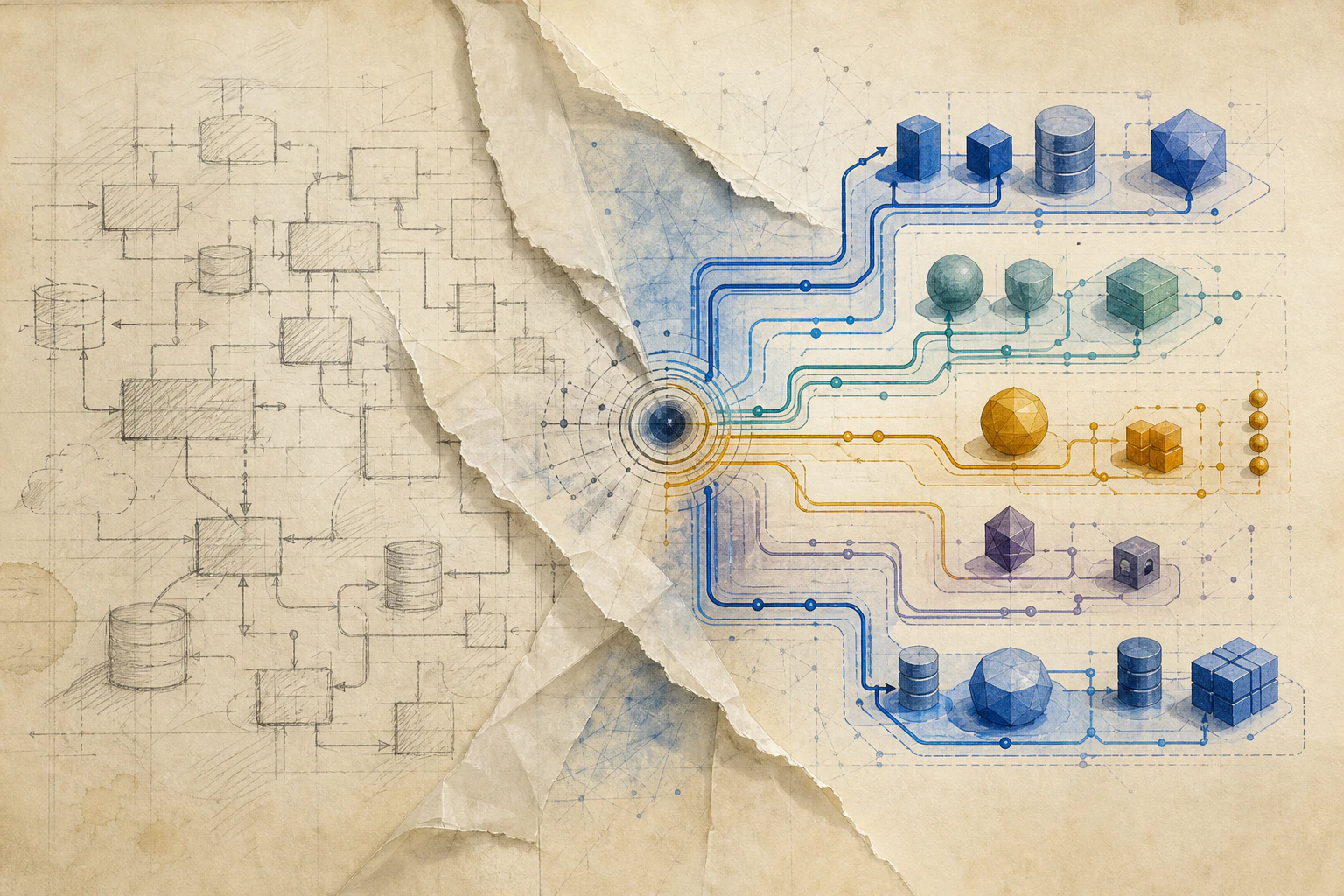
Architecture diagrams are useful because they explain intent. They show service boundaries, trust zones, major data flows, and design decisions in a form people can discuss. Their weakness is not the medium; it is the maintenance model. A diagram captures what someone understood at a moment in time, while an AWS environment can change through deployments, console actions, automation, scaling, policy updates, and managed-service behavior every day.
AWS dependency mapping addresses a different need. It builds an evidence-backed model of which resources and workloads rely on one another, where each relationship came from, when it was observed, and how confident the system should be in it. The result is not a prettier static diagram. It is a continuously reconciled dependency graph that supports incident investigation, change-impact analysis, failure simulation, security review, and recovery planning.
This guide explains how to build such a map without pretending that a single API, tag strategy, or tracing system can reveal every dependency. It covers explicit and implicit relationships, configuration and runtime evidence, stable identity, directionality, multi-account boundaries, confidence, stale edges, validation, and a practical review workflow.
Table of contents
- Why diagrams drift
- Define dependency before collecting data
- Start with resource identity
- Map explicit configuration dependencies
- Find implicit dependencies
- Combine configuration and runtime evidence
- Represent direction, type, and criticality
- Handle multi-account and multi-region boundaries
- Manage confidence and stale relationships
- Build continuous discovery
- Validate with engineers
- A practical dependency-review workflow
- Common failure modes
- Key takeaways
- Frequently asked questions
Why diagrams drift
The first version of a cloud architecture diagram is often accurate. It is produced during design review, migration, or service launch, when the team has reason to agree on the system boundary. Drift begins after that moment.
An engineer adds an SQS queue to absorb bursts. A Lambda function is attached as a consumer. A new KMS key protects the queue. A VPC endpoint is introduced for private access. A security group is shared with another workload to solve a deadline problem. A database migration creates a temporary replica that becomes permanent. A vendor API moves behind a new DNS name. Each change may be reasonable, reviewed, and deployed correctly. Few workflows require the architecture diagram to be updated with the same rigor as code.
Diagrams also simplify deliberately. A box labeled “application” can conceal task definitions, services, target groups, IAM roles, secrets, subnets, route tables, endpoints, queues, and certificates. This abstraction is helpful in an executive review but insufficient when a route-table change interrupts access to Secrets Manager.
Some drift is not documentation failure at all. Autoscaling changes resource instances. Managed services create and replace infrastructure. Infrastructure-as-code can express conditional resources and modules that are not obvious in a rendered plan. Cross-account event buses, shared VPCs, transit gateways, and centralized identity introduce relationships owned by different teams.
The lesson is not to abandon diagrams. Continue using them to communicate design intent. Use a continuously discovered dependency model to test and update that intent.
Define dependency before collecting data
Teams often begin by collecting every available API response and only later decide what the graph means. A more reliable approach starts with relationship semantics.
A dependency exists when the availability, correctness, security, performance, or recoverability of one component is meaningfully affected by another. That definition includes several classes:
- Request dependency: A service calls an API or endpoint.
- Data dependency: A workload reads or writes a database, queue, stream, bucket, or cache.
- Identity dependency: A principal needs a role, policy, token, or directory.
- Cryptographic dependency: A resource needs a KMS key, certificate, or secret.
- Network dependency: Traffic relies on a subnet, route, security group, network ACL, gateway, endpoint, or DNS path.
- Deployment dependency: A release relies on an artifact, pipeline, stack output, or shared module.
- Operational dependency: Recovery relies on a runbook, owner, backup, or approval.
- Ownership dependency: A customer-facing capability relies on a component operated by another team.
These relationships do not all behave alike. A synchronous database dependency usually has a different time-to-impact than an asynchronous queue. A route table enables connectivity but is not called like an API. An IAM permission affects authorization rather than endpoint availability. Edge types should preserve those differences.
Dependency mapping also needs a declared scope. Are you mapping infrastructure-only relationships, application calls, customer capabilities, or recovery prerequisites? A graph can grow indefinitely. The correct scope follows the decisions it must support.
For change review, configuration and shared-resource dependencies may be most important. For incident response, runtime paths and recent changes matter. For resilience planning, alternative paths, recovery order, and ownership become essential.
Start with resource identity
Relationship quality depends on node identity. If the same resource appears as separate nodes in CloudTrail, Terraform, CloudWatch, and service APIs, paths will break. If two similarly named resources are merged, paths become false.
AWS provides Amazon Resource Names for many resource types, but ARN support and format vary. A robust identity strategy may combine:
- Partition
- AWS account ID
- Region
- Availability Zone where applicable
- Service
- Resource type
- Provider resource identifier
- Canonical ARN where available
- Global or regional scope
Names and tags are attributes, not primary identity. A bucket name is globally unique at a given time, but an EC2 instance Name tag is not. An IAM role is global within an account, while an RDS instance is regional. Route 53 hosted zones and CloudFront distributions have different scoping rules from VPC resources.
Identity must persist through observations. When a resource is deleted, the historical node should remain addressable. When infrastructure replacement creates a new provider identifier behind the same application role, the model should represent continuity at the workload level without pretending the physical resource is unchanged.
Cross-system matching needs provenance. A Terraform address such as module.checkout.aws_ecs_service.app represents declared infrastructure. The resulting ECS service ARN represents an AWS resource. Connecting them may use state data, tags, deployment events, or explicit mappings. Store the reason for the match.
Map explicit configuration dependencies
Explicit dependencies are the safest place to start because a resource configuration directly names or contains another resource.
Examples include:
- A target group contains registered targets.
- An Application Load Balancer listener forwards to a target group.
- An ECS service references a task definition and load balancer configuration.
- A Lambda event-source mapping connects a queue or stream to a function.
- A database uses a DB subnet group and security groups.
- An S3 bucket uses a KMS key.
- A Route 53 alias points to an AWS endpoint.
- A CloudFormation stack output is imported by another stack.
- An IAM role trust policy permits a principal to assume it.
For each resource type, define relationship extraction rules. A rule should identify:
- The source resource.
- The target resource.
- The edge type and direction.
- The configuration field that provides evidence.
- Observation time.
- Scope and identity resolution.
- Confidence.
Keep the original provider response or a controlled evidence fragment so investigators can verify the conclusion. Do not store sensitive values unnecessarily. A secret reference is useful; the secret value is not required for topology.
Infrastructure-as-code adds declared relationships. Terraform references create a dependency graph during planning, and CloudFormation derives dependencies from resource references in addition to explicit DependsOn. Declared edges describe intended deployment ordering or configuration, not necessarily runtime criticality. Preserve that distinction.
Tags can add ownership, environment, application, or criticality context. Tags should rarely create high-confidence technical dependencies on their own. Tag quality varies, and similarly labeled resources may not communicate.
Explicit mapping produces a strong base but leaves important gaps. Applications can construct endpoints at runtime, retrieve destinations from configuration, call external APIs, or publish messages without an infrastructure configuration naming the consumer.
Find implicit dependencies
Implicit dependencies require correlation. No single resource field proves the relationship, but multiple observations may support it.
Network evidence
VPC Flow Logs can show network flows associated with network interfaces, addresses, ports, and acceptance status. They do not automatically identify application semantics, and traffic may pass through load balancers, proxies, or network address translation. Correlation with resource-to-interface mappings and time windows can support a likely network edge.
A flow proves observed communication, not business criticality. Health checks, vulnerability scans, backups, or one-time administrative actions may create traffic. Frequency, direction, protocol, recurrence, and workload context help classify it.
Distributed tracing
OpenTelemetry and application tracing can reveal service-to-service paths, spans, and remote endpoints. Trace context is valuable because it aligns dependency with requests. Coverage may be sampled, incomplete, or inconsistent across languages and teams. A dependency absent from traces is not necessarily absent from production.
Logs and metrics
Application logs may mention resource names, queues, buckets, or endpoints. CloudWatch metrics can reveal correlated activity but rarely prove causation alone. Logs should be processed with data-minimization controls because they may contain sensitive fields.
IAM and access evidence
An IAM policy can permit access to a resource. Permission is a potential security or operational path, not proof that access occurs. CloudTrail data events, where configured and supported, may show use. Model “can access” separately from “observed accessing.”
Secrets and configuration
Environment variables, parameter names, and secret references can connect a workload to an endpoint or credential. Avoid collecting secret contents. Often the resource reference and workload configuration are sufficient.
Deployment and repository context
Pipeline metadata, Terraform state, CloudFormation stacks, and service catalogs can connect resources to applications and owners. Repository code may reveal clients or endpoints, but static analysis has language and configuration limits. Treat it as supporting evidence.
Human knowledge
Engineers know about operational dependencies that machines cannot observe, including manual recovery approvals or third-party contractual requirements. User-supplied edges are valid when labeled with source, owner, and review date. They should expire or request review rather than remain permanently unquestioned.
Combine configuration and runtime evidence
Configuration and runtime data answer different questions.
Configuration says a path is enabled or intended. Runtime evidence says a path was observed during a window. Neither is complete in isolation.
Suppose an ECS task role can read two secrets, and the task definition references both. Configuration supports two dependency edges. Runtime events may show only one secret accessed during the last seven days. That does not prove the second is unused; it may support a rare administrative workflow. The graph can show both edges with different observation context.
Conversely, network flow may reveal calls to an endpoint not represented in infrastructure-as-code. That observation can create an inferred runtime edge and trigger review. The endpoint could be dynamically configured or external.
A practical evidence hierarchy is not a universal score but a set of explainable rules:
- Direct provider reference: strong configuration evidence.
- Infrastructure-as-code reference matched to deployed identity: strong declared evidence.
- Repeated trace relationship: strong observed application evidence within the trace window.
- Recurrent network flow plus identity correlation: moderate observed evidence.
- IAM permission only: potential access path, not observed use.
- Naming or tag similarity: weak contextual evidence.
- Engineer validation: strong human evidence with a review date.
Combining evidence can raise confidence, but the interface should expose the ingredients. “Confidence: high” is insufficient without “because the listener forwards to this target group and traffic was observed.”
Represent direction, type, and criticality
A graph edge must answer more than “connected.”
Direction affects traversal. If a service reads a database, impact generally propagates from database failure toward the service, while a dependency query from the service traverses toward the database. Store a semantic direction and let analysis choose traversal rules.
Type affects behavior. A cache may be optional, degraded, or required. A queue decouples producer and consumer. A DNS record resolves an endpoint. An IAM role authorizes access. Collapsing these into “depends on” discards the information simulation needs.
Criticality should not be inferred from traffic volume alone. A rarely used account-recovery path can be critical. A high-volume analytics stream may tolerate delay. Capture whether an edge is:
- Required
- Optional
- Degradable
- Redundant
- Fallback
- Administrative
- Unknown
Time-to-impact and tolerance also matter. A service may continue with cached configuration for an hour. A queue outage may not affect customers until retention or backlog thresholds are crossed. These properties are assumptions and should be reviewed.
Handle multi-account and multi-region boundaries
Modern AWS environments commonly separate production, development, security, networking, and shared services across accounts. A dependency map must preserve those boundaries while still connecting approved cross-account paths.
Use a tenant- and account-aware identity model. Collection permissions should be explicit per account. A failure to assume one role must appear as a coverage gap, not an empty environment.
Cross-account relationships include:
- IAM trust policies
- Resource policies
- EventBridge event buses
- Shared VPC participation
- Transit Gateway attachments
- Route 53 Resolver rules
- KMS grants
- S3 bucket policies
- Container or artifact repositories
- Centralized logging
Region is equally important. Some resources are global, others regional, and others tied to an Availability Zone. A route or endpoint in one Region cannot be casually treated as equivalent to another. Replication is a relationship, not identity.
Organizations metadata can provide account context, but do not assume organizational hierarchy equals application ownership. Shared services often cut across organizational units.
For security, collectors should use least privilege, short-lived credentials, and clear audit trails. Cross-account discovery should remain separate from remediation permissions. An operational graph can contain sensitive topology; tenant isolation and authorization must apply to queries and exports as well as ingestion.

Manage confidence and stale relationships
Dependency maps decay unless relationships have time semantics.
Every edge should include:
- First observed time
- Most recent observed time
- Evidence source
- Evidence collection window
- Validity status
- Confidence
- Review status where applicable
When an explicit reference disappears, close the edge’s active interval but retain it historically. When runtime traffic stops, avoid deleting the edge immediately. Mark it stale according to an evidence-specific policy. A monthly billing job should not vanish because a seven-day observation window was quiet.
Confidence should decrease or request review when supporting evidence ages. Different evidence types need different expiration behavior. Provider configuration remains valid until a later observation changes it. Runtime evidence becomes less representative as the observation window recedes. Human assertions should have review dates.
False precision is a common failure. A confidence number such as 83 percent suggests statistical calibration that may not exist. Explainable levels—confirmed, strong, moderate, weak, unknown—can be more honest when accompanied by evidence.
Users should be able to:
- Confirm an inferred edge
- Reject it with a reason
- Mark it optional
- Add business context
- Set an owner
- Request revalidation
- See whether automation or a user created it
User validation must not overwrite raw evidence. Preserve both the observation and the decision.
Build continuous discovery
A continuously useful map needs both event-driven updates and reconciliation.
CloudTrail can provide API activity for supported events and helps connect changes to actors and time. It is not a complete configuration database. AWS Config can record configuration changes for supported resource types when enabled. Direct service APIs supply detailed current state. Infrastructure pipelines provide declared change context. Runtime sources provide observed behavior.
A common pipeline includes:
- Assume an approved read-only role.
- Enumerate accounts and Regions within scope.
- Query supported services with pagination and throttling controls.
- Normalize resource identities and configurations.
- Extract explicit relationships.
- Correlate declared and runtime evidence.
- Compare with previous state.
- Open and close temporal validity intervals.
- Record coverage, errors, and freshness.
- Trigger analysis for material changes.
Incremental updates reduce latency, while scheduled full reconciliation repairs missed events and source inconsistencies. Idempotency prevents duplicated nodes and edges.
Partial failure is normal. An API may throttle, a Region may be disabled, or one account may deny a service action. Store collection status by source and scope. A green “sync complete” indicator is misleading if 12 percent of service queries failed.
Validate with engineers
Automated discovery can expose more detail than a diagram, but engineers provide critical context.
Validation works best as a focused review rather than asking owners to approve a massive graph. Select one workload and show:
- Inbound paths
- Required downstream dependencies
- Shared resources
- Identity and encryption paths
- Cross-account edges
- Low-confidence inferences
- Stale relationships
- Ownership gaps
Ask concrete questions:
- Is this dependency required for the customer-facing path?
- Does the service have a fallback?
- How long can it operate without this resource?
- Is this shared security group intentional?
- Who owns recovery of this queue?
- Is this trace absence expected or an instrumentation gap?
Record answers as reviewed context with an owner and date. Revisit them after significant architectural change.
The purpose is not to make humans curate every edge. It is to direct attention toward ambiguity and operational importance while automation maintains observable facts.
A practical dependency-review workflow
Hypothetical example: A platform team wants to review an order-processing workload before narrowing egress rules.
Step 1: Define scope
The team selects the ECS service, its production account, the synchronous request path, and asynchronous fulfillment path. They exclude development accounts and document that external payment-provider behavior is outside the infrastructure model.
Step 2: Refresh discovery
The system refreshes the relevant service, VPC, IAM, Secrets Manager, RDS, SQS, KMS, and Route 53 resources. It reports one permission gap for a centralized DNS account, which the reviewer sees immediately.
Step 3: Inspect explicit edges
Configuration shows the service registered with a target group, attached to security groups, using a task role, reading named parameters, and publishing to a queue. The queue uses a KMS key in the same account.
Step 4: Overlay runtime evidence
Traces show outbound calls to payment and tax services. Network evidence shows periodic access to a shared proxy. The proxy was absent from the architecture diagram.
Step 5: Review uncertainty
A broad IAM policy permits access to several queues, but only one is referenced in configuration. Those are shown as potential access paths rather than runtime dependencies.
Step 6: Analyze the proposed change
The new egress rule would block the shared proxy path. The graph identifies the order service and another workload as dependents. Evidence links the edge to recurring observed traffic and the proxy’s network interface.
Step 7: Validate and decide
Engineers confirm the proxy is required for two external APIs. They modify the proposal to allow the proxy endpoint and schedule a separate review of the broad IAM policy.
This workflow is more defensible than trusting either a stale diagram or an unfiltered flow-log query. It connects the proposed change to typed dependencies, source evidence, known gaps, and human confirmation.
Common failure modes
Treating every connection as a dependency
Administrative scans, health checks, backups, and one-time migrations generate traffic. Classify purpose and recurrence before declaring criticality.
Treating permission as usage
IAM access is a potential path. Separate “can access” from “observed accessing” and from “required to operate.”
Using tags as proof
Tags add valuable context but are often inconsistent. They should support, not replace, technical evidence.
Ignoring time
Deleting old edges loses incident context; retaining them as active creates false paths. Use validity intervals and stale states.
Hiding gaps
Missing permission, disabled logging, or unsupported resource coverage must be visible. An incomplete graph should not look complete.
Showing topology spaghetti
A graph with every edge is hard to use. Provide workload scope, path queries, aggregation, ownership filters, and criticality views.
Mapping only deployed configuration
Configuration misses dynamic endpoints and external services. Add runtime evidence where appropriate.
Mapping only runtime traffic
Runtime data misses rare paths, failover routes, and idle dependencies. Combine it with configuration and declared state.
Assuming the graph is truth
The graph is an evidence-backed model. Preserve uncertainty, support validation, and refresh before high-risk decisions.
Key takeaways
- Architecture diagrams communicate intent but cannot reliably maintain detailed operational state.
- AWS dependency mapping begins with stable resource identity and explicit relationship semantics.
- Configuration evidence and runtime evidence are complementary.
- Typed, directed edges support better impact analysis than generic connections.
- Account, Region, environment, and tenant boundaries must remain visible.
- Every inferred relationship needs provenance, observation time, and confidence.
- Stale edges should be retained historically without appearing active.
- Human validation is most effective when focused on ambiguous, critical paths.
- Continuous reconciliation is required because cloud topology keeps changing.
Frequently asked questions
Can AWS tags create a complete dependency map?
No. Tags can identify owner, environment, or application context, but they rarely prove technical dependency. Combine them with provider configuration, infrastructure-as-code, events, runtime evidence, and review.
Is VPC Flow Logs data enough?
Flow logs can support network relationships, but they do not automatically explain application semantics or criticality. They may also omit non-network dependencies and require careful identity correlation.
How should cross-account dependencies be represented?
Preserve both resource identities and account boundaries, then create explicit cross-account edges supported by trust policies, resource policies, routing, shared-service configuration, or runtime evidence.
What happens when evidence sources disagree?
Show the disagreement. Declared configuration, observed state, and runtime behavior can diverge. The discrepancy may reveal drift, dormant paths, instrumentation gaps, or a faulty inference.
Does dependency mapping require write access?
Discovery and mapping can be designed around read-only access. Any remediation capability should use a separate, tightly controlled permission path with policy checks, auditability, and human approval.
Conclusion
AWS dependency mapping is not the act of drawing lines between cloud icons. It is the disciplined construction of an identity-aware, typed, temporal, and explainable model. The map becomes trustworthy when users can see what was observed, what was inferred, when evidence was collected, and where coverage remains incomplete.
Architecture diagrams still have an important role: they communicate how a system is supposed to work. A continuously discovered graph adds the operational counterpart—how the environment is configured, what behavior was observed, and which paths may matter during a change or incident. Together, they let teams move from memory and assumptions toward evidence-backed cloud operations.
Primary sources and further reading
- AWS Config resource configuration tracking
- AWS CloudTrail concepts
- VPC Flow Logs
- IAM policy evaluation logic
- AWS Resource Explorer
- Terraform dependency graph
- CloudFormation DependsOn
- OpenTelemetry traces
Related StackScopes reading
Continue exploring
Map the path behind the risk.
Explore cloud topology, failure simulation, blast radius, and evidence-backed recovery with StackScopes.